Software & Web Development

Data Science & Robotics Development

Calc LLC provide high quality services at very competitive rate

Late‑Winter U.S. Ag Weather Outlook: National Summary, Regional Impacts, and 7‑Day Hazards

Late‑Winter U.S. Ag Weather Outlook: National Summary, Regional Impacts, and 7‑Day Hazards

Late-winter U.S. agriculture faces rapid swings: intermittent rain/snow, brisk post-frontal winds, and patchy frost from the Southeast to western valleys. Fieldwork windows are short and regional. Watch West Coast storm-track pulses, Gulf-front showers/storms, and Southern High Plains fire weather. Protect blooming crops and livestock; consult local NWS forecasts.

Weather

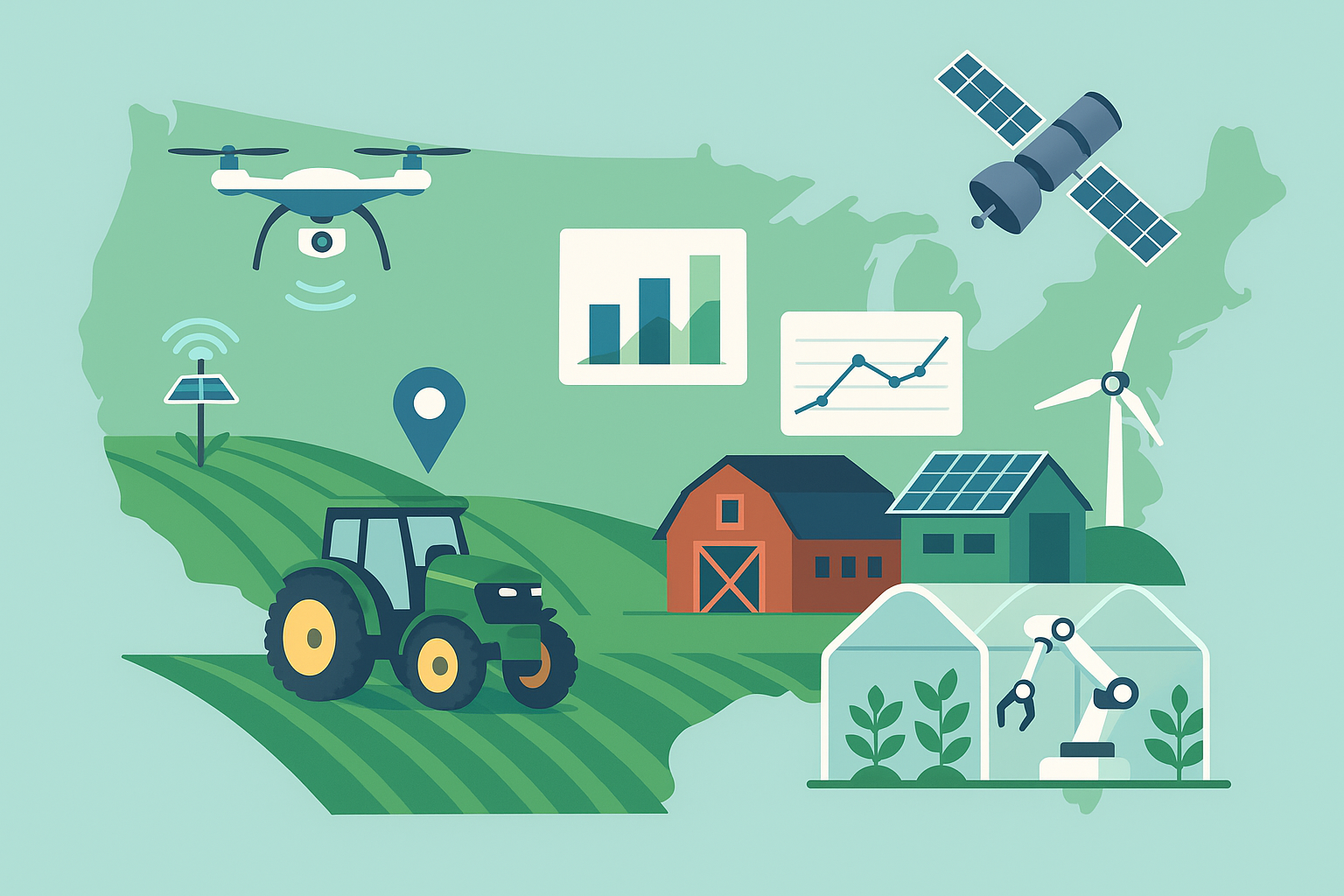
At Field Speed: On-the-Go Soil Sensing Powers Closed-Loop, Variable-Rate Agronomy

On-the-go soil sensors mounted on planters map soils in real time, calibrated with lab cores to guide variable-rate seeding, nitrogen, lime, and planter downforce. Fusing EC/EMI, vis–NIR, gamma, and compaction data improves input efficiency, yield stability, and sustainability, with payback in 1–3 seasons despite moisture, residue, and calibration challenges.

Tech

U.S. Agriculture Policy: Seven-Day Outlook on Funding, Farm Bill Talks, and Regulatory Moves

U.S. farm policy this week centers on securing funding, negotiating farm-nutrition packages, and clarifying environmental, water, and trade rules. Expect congressional oversight, draft text, USDA and EPA updates, and trade signals. Producers watch crop insurance, conservation enrollments, compliance guidance, biofuels incentives, and export data shaping risk management and planting decisions.

Politics
Fire, Flood, and Freight: How October 9 Repeatedly Reshaped American Agriculture

Fire, Flood, and Freight: How October 9 Repeatedly Reshaped American Agriculture

Across October 9 milestones, U.S. agriculture confronts shocks and adapts: the 1871 Chicago and Peshtigo fires reshaped grain trade and land management; 2002 port reopening unclogged exports; 2017 Wine Country fires complicated harvests; 2016 Matthew floods swamped Carolina farms—spotlighting risk, redundancy, standards, and climate-driven resilience.

October 8's Legacy in U.S. Agriculture: Fire, Flood, Policy, and Climate

October 8's Legacy in U.S. Agriculture: Fire, Flood, Policy, and Climate

October 8 threads pivotal moments in U.S. agriculture: the devastating 1871 Peshtigo Fire, 2016 Hurricane Matthew flooding, 2001 homeland security reforms, a 2013 shutdown exposing reliance on USDA services, and 2018 climate science that shape resilience through stronger biosecurity, data, infrastructure, and climate-smart, risk-aware practices.

October 7: Turning Points in American Agriculture

October 7: Turning Points in American Agriculture

October 7 threads through U.S. agriculture: Cornell’s 1868 opening propelled land‑grant science; Henry A. Wallace (born 1888) fused genetics and New Deal policy; 2018’s Michael formed, devastating harvests days later; and the 2013 shutdown exposed reliance on USDA services—reminders, amid peak harvest season, of innovation, risk, and public infrastructure.

October 6 in U.S. Agriculture: Supply Chains, Shocks, and Resilience

October 6 in U.S. Agriculture: Supply Chains, Shocks, and Resilience

October 6 threads through U.S. agriculture: a 1866 train robbery exposing supply-chain risks; 1973 war-triggered oil shock inflating fuel and fertilizer; 2013 USDA data blackout; 2016 hurricane scramble; 2015 TPP reactions. Coupled with 4-H and Co-op observances and peak harvest logistics, it highlights intertwined vulnerabilities, institutions, and resilience.

October 5 in U.S. Agriculture: How Land, Policy, Trade, and Media Shaped the Farm Gate

October 5 in U.S. Agriculture: How Land, Policy, Trade, and Media Shaped the Farm Gate

October 5 threads pivotal U.S. agriculture moments: Chief Joseph’s 1877 surrender reshaping Northwest lands; Truman’s 1947 food conservation; 2001 actions leading to the 2002 Farm Bill; 2015 TPP deal; PBS’s 1970 launch; 2017 tax pathway—plus typical early-October harvests—showing how policy, trade, media, and seasons shape farm economies.

October 4 in U.S. Agriculture: From Land-Grant Roots to Disaster Resilience

October 4 in U.S. Agriculture: From Land-Grant Roots to Disaster Resilience

October 4 has repeatedly shaped U.S. agriculture—from Texas A&M's 1876 land-grant debut to Hurricane Opal (1995), the "Cattlemen's Blizzard" (2013), and South Carolina's 2015 floods—driving advances in extension, resilience, and disaster policy, while annual observances elevate animal welfare, farm-to-school markets, pork promotions, and cooperative economics.

Harvest’s Hinge: October 3 Moments That Shaped U.S. Agriculture

Harvest’s Hinge: October 3 Moments That Shaped U.S. Agriculture

On October 3 across U.S. history, milestones shaped agriculture: Thanksgiving proclamations aligning civic life with harvests (1789, 1863); the 1965 immigration law remaking farm labor; 2008 TARP shoring rural credit; and 2013–2015 storms devastating herds and crops—underscoring farms’ dependence on workers, markets, policy, and weather.

October 2’s Imprint on U.S. Agriculture: From the Texas Revolution to Landmark Conservation

October 2’s Imprint on U.S. Agriculture: From the Texas Revolution to Landmark Conservation

October 2 has repeatedly reshaped U.S. agriculture: from the 1835 Battle of Gonzales, accelerating cotton and cattle expansion, to 1968 conservation milestones safeguarding rivers, trails, and forests. These policies still guide water use, land access, flood resilience, and rural economies, aligning production with stewardship across today's working landscapes.