Software & Web Development

Data Science & Robotics Development

Calc LLC provide high quality services at very competitive rate

Late‑Winter U.S. Ag Weather Outlook: National Summary, Regional Impacts, and 7‑Day Hazards

Late‑Winter U.S. Ag Weather Outlook: National Summary, Regional Impacts, and 7‑Day Hazards

Late-winter U.S. agriculture faces rapid swings: intermittent rain/snow, brisk post-frontal winds, and patchy frost from the Southeast to western valleys. Fieldwork windows are short and regional. Watch West Coast storm-track pulses, Gulf-front showers/storms, and Southern High Plains fire weather. Protect blooming crops and livestock; consult local NWS forecasts.

Weather

At Field Speed: On-the-Go Soil Sensing Powers Closed-Loop, Variable-Rate Agronomy

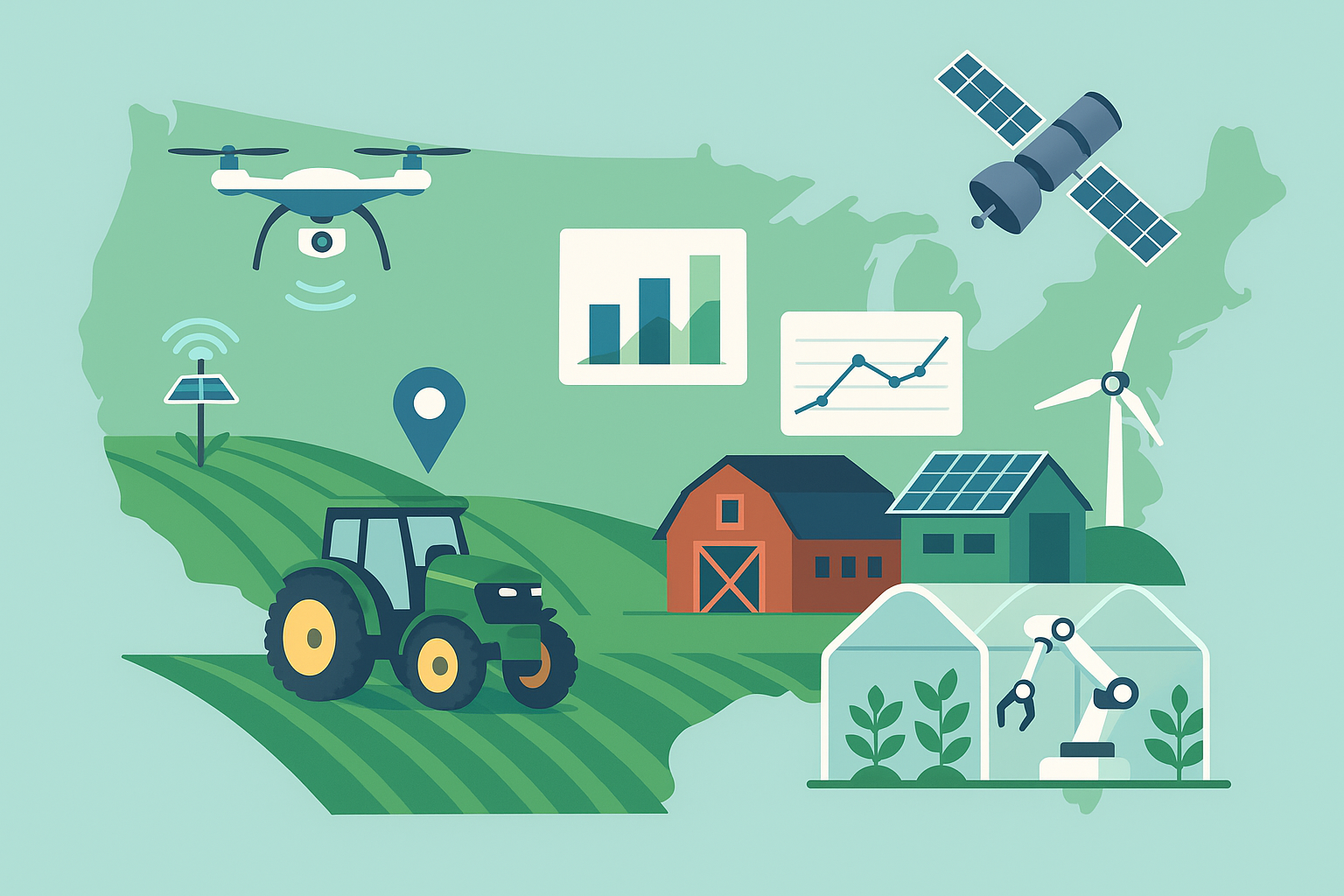
On-the-go soil sensors mounted on planters map soils in real time, calibrated with lab cores to guide variable-rate seeding, nitrogen, lime, and planter downforce. Fusing EC/EMI, vis–NIR, gamma, and compaction data improves input efficiency, yield stability, and sustainability, with payback in 1–3 seasons despite moisture, residue, and calibration challenges.

Tech

U.S. Agriculture Policy: Seven-Day Outlook on Funding, Farm Bill Talks, and Regulatory Moves

U.S. farm policy this week centers on securing funding, negotiating farm-nutrition packages, and clarifying environmental, water, and trade rules. Expect congressional oversight, draft text, USDA and EPA updates, and trade signals. Producers watch crop insurance, conservation enrollments, compliance guidance, biofuels incentives, and export data shaping risk management and planting decisions.

Politics
September 15: Turning Points in American Agriculture

September 15: Turning Points in American Agriculture

September 15 repeatedly marks turning points in U.S. agriculture: Washington’s response to the Whiskey Rebellion, Khrushchev’s farm diplomacy opening, a 2022 rail-strike avert, the 2006 spinach E. coli reckoning, and Florence’s 2018 floods—illustrating how policy, technology, supply chains, and climate shocks shape farms, markets, and food safety.

September 14: The Quiet Fulcrum of U.S. Agriculture

September 14: The Quiet Fulcrum of U.S. Agriculture

September 14 has repeatedly reshaped U.S. agriculture: Florence’s floods devastated Carolina farms (2018); a deadly cantaloupe-linked Listeria alert rewrote produce safety (2011); Roosevelt’s accession set irrigation and conservation in motion (1901); the Gregorian switch standardized planting records (1752); and OPEC’s founding redefined energy costs—underscoring resilience and systems-level risk management.

September 13’s Disasters: How One Date Keeps Reshaping American Farming

September 13’s Disasters: How One Date Keeps Reshaping American Farming

September 13 has repeatedly tested U.S. agriculture, from 2008’s Hurricane Ike to Colorado’s 2013 floods and California’s 2015 Valley Fire, with 2018 Florence preparations and 2020 smoke compounding. Mid-September shocks disrupted harvests, livestock, and infrastructure, spurring reliance on federal aid, insurance, hardening, irrigation upgrades, and faster regional coordination.

September 12: A Pivotal Date in U.S. Agriculture—from Borlaug’s Legacy to Floods and Market-Moving Reports

September 12: A Pivotal Date in U.S. Agriculture—from Borlaug’s Legacy to Floods and Market-Moving Reports

September 12 threads U.S. agriculture’s science, risk, and markets: remembering Norman Borlaug’s Green Revolution and World Food Prize; recalling 2013 Colorado floods that wrecked farms and irrigation; noting USDA September reports that sway prices and plans; and marking mid-September’s harvest pivot, conservation tasks, and risk management across diverse regions.

September 11’s Imprint on U.S. Agriculture: Security Shocks, Natural Disasters, and the Rise of Resilience

September 11’s Imprint on U.S. Agriculture: Security Shocks, Natural Disasters, and the Rise of Resilience

Across multiple September 11 anniversaries, shocks reshaped U.S. agriculture: 2001 security disruptions spawned modern food defense; 2013 Colorado floods battered crops and irrigation; 2017 Irma devastated Florida farming; 2020 wildfire smoke strained West Coast harvests. The throughline: resilient logistics, biosecurity, hardened infrastructure, trained networks, and risk programs sustain food systems.

September 10 at Hurricane Peak: From Donna to Irma, the Day U.S. Agriculture Is Tested

September 10 at Hurricane Peak: From Donna to Irma, the Day U.S. Agriculture Is Tested

September 10, the climatological peak of Atlantic hurricanes, has repeatedly reshaped U.S. agriculture—most notably via Florida landfalls by Donna (1960) and Irma (2017). Their wind and flood damage spurred huge losses, policy shifts (disaster aid, insurance), and enduring farm practices: pruning, windbreaks, drainage, hardened structures, power redundancy, and diversified harvests.

September 9: Turning Points in American Agriculture—Statehood, Strikes, Storms, and Smoke

September 9: Turning Points in American Agriculture—Statehood, Strikes, Storms, and Smoke

September 9 repeatedly marks turning points in U.S. agriculture: California’s 1850 statehood propelled irrigated specialty crops; the 1965 Delano strike galvanized farmworker rights; 2017 Hurricane Irma forced Florida into emergency resilience; and 2020’s wildfire smoke threatened grape quality—highlighting enduring battles over land, water, labor, risk, and adaptation.

Rails, Storms, Statutes, and Strikes: September 8’s Turning Points in American Agriculture

Rails, Storms, Statutes, and Strikes: September 8’s Turning Points in American Agriculture

On September 8, events reshaped U.S. agriculture: Northern Pacific railway integrated Plains markets, Galveston hurricane exposed coastal vulnerability, Defense Production Act imposed wartime supply controls, and the Delano grape strike advanced farmworker rights—showing how infrastructure, climate risk, security policy, and labor justice steer the food system.