Software & Web Development

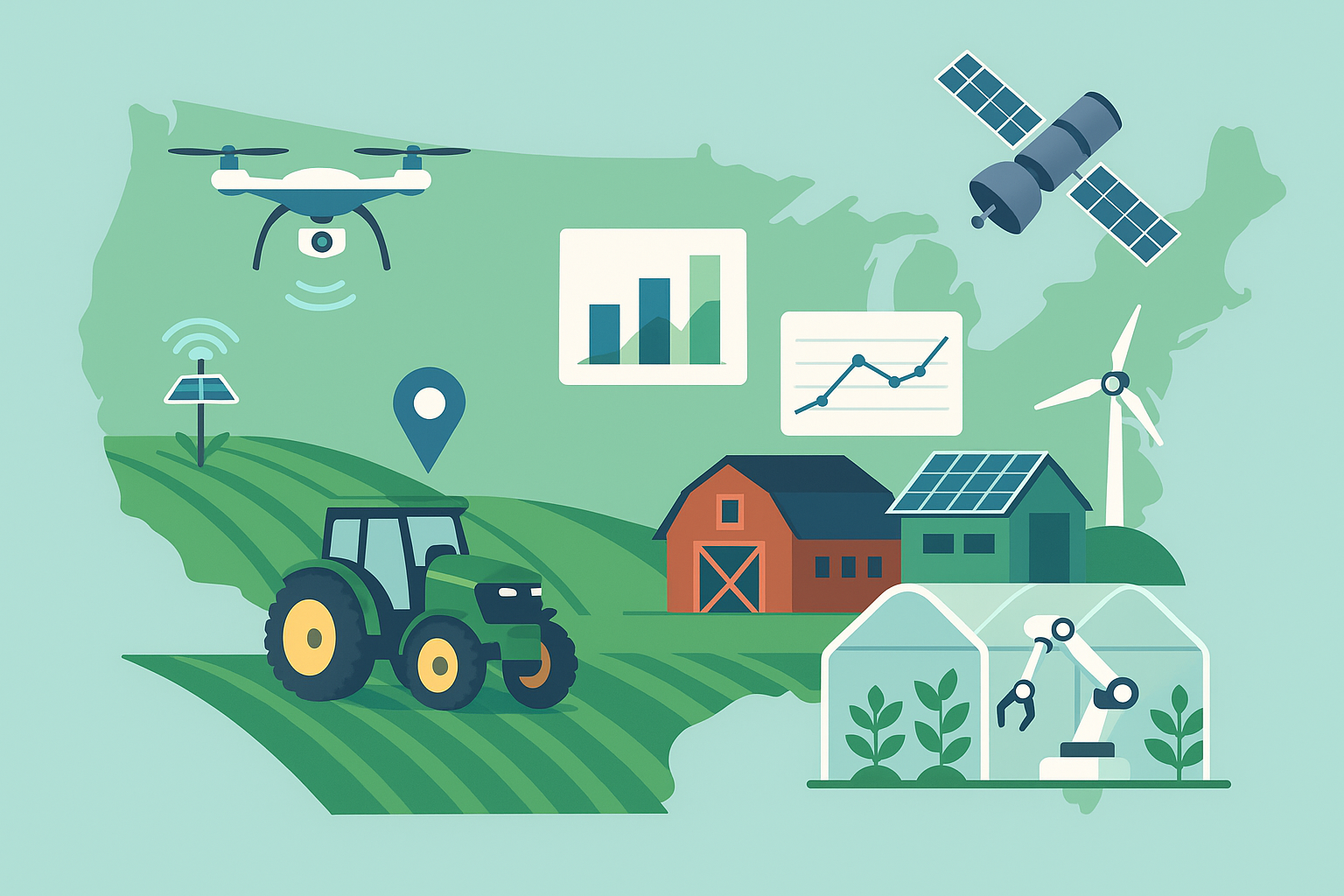
Data Science & Robotics Development

Calc LLC provide high quality services at very competitive rate

U.S. Late-February Ag Weather Planner: 7-Day Regional Outlook, Risks, and Fieldwork Guidance

U.S. Late-February Ag Weather Planner: 7-Day Regional Outlook, Risks, and Fieldwork Guidance

Late-February U.S. farm outlook: expect frontal passages bringing brief precipitation and wind, then cooler, drier breaks. Risks include intermittent frost, variable moisture from West storms to Plains/Midwest mix, and trafficability issues. Use short spray/topdress windows, protect blooms and livestock, time nitrogen with light rains, and monitor local forecasts.

Weather

From Sunlight to Shelf Life: PCM Thermal Storage Reinvents Farm Cold Rooms

Farm cold rooms using phase-change materials act as thermal batteries, enabling efficient pre-cooling and storage where power is scarce. By banking cold during sunny or low-tariff hours, they cut spoilage, fuel use, and compressor wear. The piece outlines design, operations, economics, best-fit cases, purchasing criteria, policy supports, and next steps.

Tech

Quiet Levers, Big Moves: The Week Ahead in U.S. Agriculture Policy

U.S. agriculture policy is shifting through Congress, USDA rules, EPA decisions, trade moves, court orders, and statehouse bills. Near-term signals—appropriations riders, hearings, pesticide and fuel guidance, export actions, and litigation—could alter inputs, risk, labor, and market access. Producers should monitor dockets and deadlines as regulatory steps sway costs and prices.

Politics
U.S. Ag Policy Pulse: Funding, Rulemaking, and Trade Risks - 7-Day Watchlist for Producers

U.S. Ag Policy Pulse: Funding, Rulemaking, and Trade Risks - 7-Day Watchlist for Producers

U.S. agriculture policy focuses on funding stability, farm safety nets, and regulatory clarity across livestock markets, pesticides/ESA, biofuels, and labor, amid volatile trade and biosecurity risks. Producers should prioritize risk management, compliance, and workforce planning while tracking federal and state moves that could rapidly shift planting, exports, margins, and expansion.

Week Ahead: Earnings vs. Inflation as U.S. Markets Reopen

Week Ahead: Earnings vs. Inflation as U.S. Markets Reopen

With U.S. markets reopening after MLK Day, thin trading gives way to positioning around inflation, policy-rate timing, and early earnings quality. Watch labor, housing, PMIs, and Treasury supply. Outcomes hinge on the growth-versus-inflation mix, steering yields, the dollar, sector leadership, and dispersion, balancing soft-landing hopes against sticky services inflation.

The January 20 Reset: How Inauguration Day Shapes U.S. Agriculture

The January 20 Reset: How Inauguration Day Shapes U.S. Agriculture

Since the 20th Amendment set inaugurations on January 20, the date has become agriculture's reset button. Incoming administrations issue regulatory freezes, shift USDA leadership, and signal priorities from climate to competition, reshaping rule timelines, program delivery, and market expectations. Examples in 2001, 2009, 2017, and 2021 show impacts on producers.

U.S. Agriculture Policy Outlook: Key Drivers, Agency Moves, and a 7‑Day Watchlist (Jan 19–25, 2026)

U.S. Agriculture Policy Outlook: Key Drivers, Agency Moves, and a 7‑Day Watchlist (Jan 19–25, 2026)

U.S. agriculture policy is driven by farm income volatility, disaster aid, conservation and climate incentives, biofuels, labor, pesticides/water, and trade. The report maps active federal, state, and congressional actions, market implications, and a Jan 19–25, 2026 monitoring plan, offering a practical checklist and sources to track rules, hearings, and deadlines.

January 19: Weather Shocks and Policy Milestones in U.S. Agriculture

January 19: Weather Shocks and Policy Milestones in U.S. Agriculture

On January 19, agriculture’s history blends weather shocks and policy shifts: Miami’s 1977 freeze imperiled Florida crops; 1994’s arctic blast strained livestock operations and logistics; and USDA’s 2017 organic welfare rule—later revised in 2023—reshaped standards. Together, they highlight adaptation through freeze protection, resilient systems, and clearer rules.

Mid-January U.S. Ag Weather Briefing and 7-Day Planning Guide

Mid-January U.S. Ag Weather Briefing and 7-Day Planning Guide

Mid-January U.S. agricultural briefing: expect frequent fronts, temperature swings, regional rain/snow, and post-frontal winds. Fieldwork windows limited outside Southwest/California. Priorities include livestock cold stress, freeze protection, drainage, and power resilience. Time sprays and field tasks to short dry breaks; monitor freezes, wind, and local forecasts via NWS and extension services.

Inline Nitrogen Sensing: Closing the Loop on Fertigation

Inline Nitrogen Sensing: Closing the Loop on Fertigation

Inline nitrogen sensing uses ion-selective electrodes to measure nitrate and ammonium in irrigation water, enabling real-time, closed-loop fertigation. Side-stream flow cells, calibration, and maintenance ensure accuracy. The approach boosts timing, verification, and compliance, suits drip and greenhouses, integrates with controls, cuts waste and risk, improving yields and water quality.