Software & Web Development

Data Science & Robotics Development

Calc LLC provide high quality services at very competitive rate

Late‑Winter U.S. Ag Weather Outlook: National Summary, Regional Impacts, and 7‑Day Hazards

Late‑Winter U.S. Ag Weather Outlook: National Summary, Regional Impacts, and 7‑Day Hazards

Late-winter U.S. agriculture faces rapid swings: intermittent rain/snow, brisk post-frontal winds, and patchy frost from the Southeast to western valleys. Fieldwork windows are short and regional. Watch West Coast storm-track pulses, Gulf-front showers/storms, and Southern High Plains fire weather. Protect blooming crops and livestock; consult local NWS forecasts.

Weather

At Field Speed: On-the-Go Soil Sensing Powers Closed-Loop, Variable-Rate Agronomy

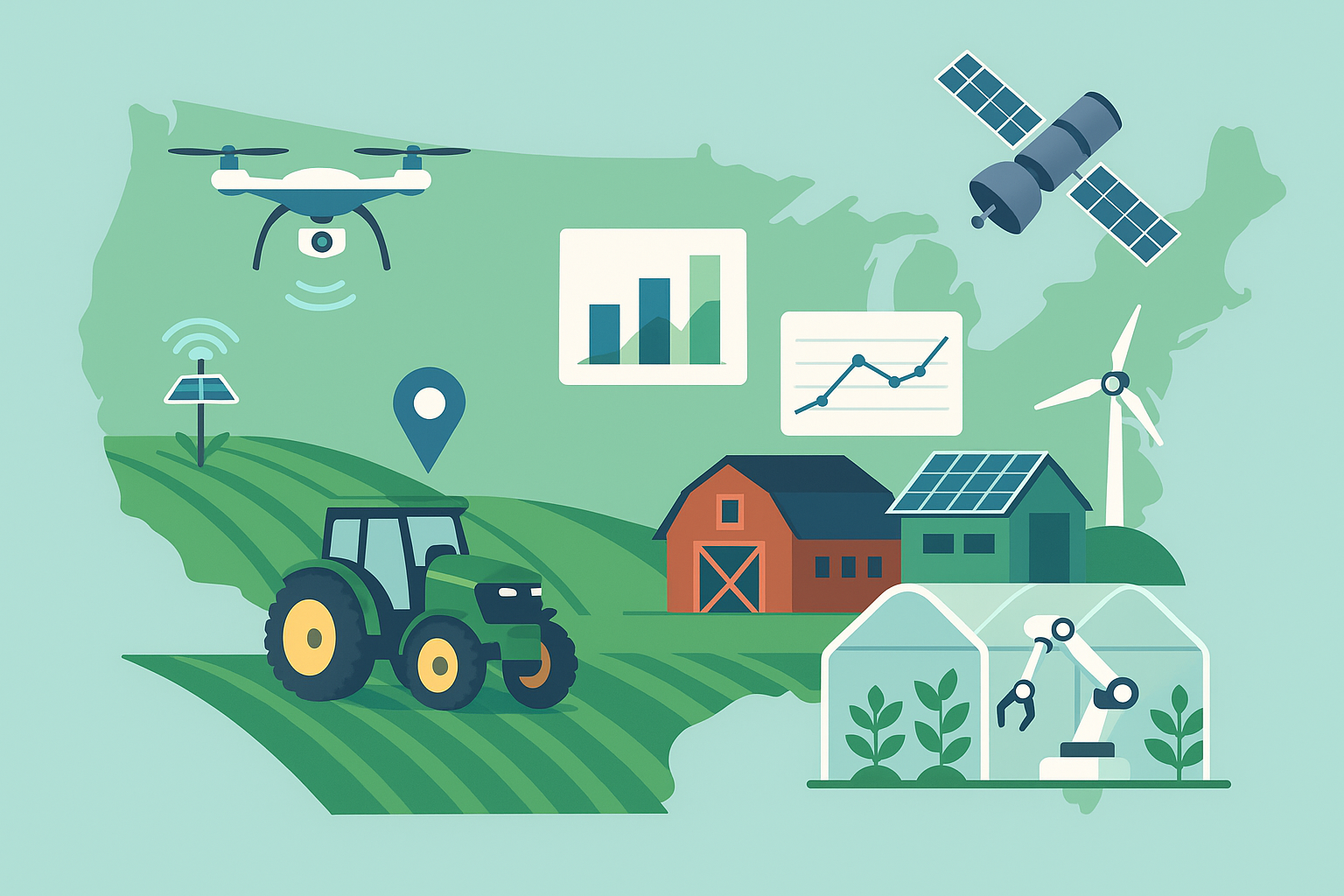
On-the-go soil sensors mounted on planters map soils in real time, calibrated with lab cores to guide variable-rate seeding, nitrogen, lime, and planter downforce. Fusing EC/EMI, vis–NIR, gamma, and compaction data improves input efficiency, yield stability, and sustainability, with payback in 1–3 seasons despite moisture, residue, and calibration challenges.

Tech

U.S. Agriculture Policy: Seven-Day Outlook on Funding, Farm Bill Talks, and Regulatory Moves

U.S. farm policy this week centers on securing funding, negotiating farm-nutrition packages, and clarifying environmental, water, and trade rules. Expect congressional oversight, draft text, USDA and EPA updates, and trade signals. Producers watch crop insurance, conservation enrollments, compliance guidance, biofuels incentives, and export data shaping risk management and planting decisions.

Politics
U.S. Agriculture Policy This Week: Farm Bill Talks, Appropriations, Trade Risks, and a 7-Day Outlook

U.S. Agriculture Policy This Week: Farm Bill Talks, Appropriations, Trade Risks, and a 7-Day Outlook

U.S. agriculture faces Farm Bill uncertainty, appropriations-driven agency capacity, and trade, regulatory, and disaster risks. Producers should monitor SNAP and safety-net debates, EPA pesticide actions, labor rules, biofuels policy, state land/water laws, and weekly federal calendars. A seven-day checklist guides tracking of hearings, grants, data, and court decisions.

Finely Balanced Markets: Disinflation vs. Growth, Fed Path, and the Week Ahead

Finely Balanced Markets: Disinflation vs. Growth, Fed Path, and the Week Ahead

Markets stayed highly data-dependent, with investors weighing disinflation versus growth and the timing of Fed easing. Rates, equities, the dollar, commodities, and credit repriced on labor/inflation data, Treasury supply, earnings, and Fed signals. The week hinges on inflation, labor, and activity; clearer disinflation supports easing, sticky inflation sustains tight conditions.

February 6 in U.S. Agriculture: From Constitutional Foundations to Winter Storm Resilience

February 6 in U.S. Agriculture: From Constitutional Foundations to Winter Storm Resilience

February 6 shows policy and weather shaping U.S. agriculture: 1788 Massachusetts ratification built national markets; 1899 Arctic cold devastated southern crops; 1978 and 2010 blizzards disrupted farms and supply chains. Each shock spurred resilience—backup power, stronger structures, planning, storage—highlighting nationwide winter risk and value of stable institutions and distributed capacity.

Precision pH: On-the-Go Soil Spectroscopy for Variable-Rate Liming

Precision pH: On-the-Go Soil Spectroscopy for Variable-Rate Liming

On-the-go vis–NIR soil spectroscopy maps pH and related properties in real time, enabling variable-rate liming that cuts lime use 20–40%, maintains yields, and reduces environmental impacts. Fusing sensors, machine learning, and precision spreaders, it turns scans into prescriptions, with field cores, while managing pitfalls like calibration, moisture, and spreader accuracy.

U.S. Ag Policy Briefing: 24-Hour Moves and the 7-Day Outlook

U.S. Ag Policy Briefing: 24-Hour Moves and the 7-Day Outlook

Washington agriculture policy saw steady activity without major breakthroughs: ongoing farm bill and appropriations talks, routine USDA rulemaking, trade friction, and state moves. The week ahead may bring hearings and regulatory releases. Stakeholders should monitor notices daily and prepare rapid responses to capture opportunities and manage risk.

Payrolls, Fed Signals, and Earnings: A Cross-Asset Playbook and 7-Day U.S. Market Outlook

Payrolls, Fed Signals, and Earnings: A Cross-Asset Playbook and 7-Day U.S. Market Outlook

U.S. markets hinge on labor data, Fed easing expectations, and earnings. Rates lead cross-asset moves; real yields steer equity leadership, while USD tracks relative rates. The next week centers on jobless claims, payrolls, auctions, surveys, and Fed speakers, with labor outcomes dictating curve, dollar, credit spreads, and sector leadership.

From Court-Packing to Crop Insurance: How FDR’s 1937 Showdown Built Modern U.S. Farm Policy

From Court-Packing to Crop Insurance: How FDR’s 1937 Showdown Built Modern U.S. Farm Policy

FDR’s 1937 court-packing bid—sparked by rulings imperiling New Deal farm programs—failed politically but catalyzed a judicial shift expanding federal economic authority. The resulting settlement anchored modern U.S. agriculture: marketing orders, price supports, production controls, crop insurance, and conservation incentives, upheld by Supreme Court decisions and still shaping farm policy today.