Software & Web Development

Data Science & Robotics Development

Calc LLC provide high quality services at very competitive rate

Late‑Winter U.S. Ag Weather Outlook: National Summary, Regional Impacts, and 7‑Day Hazards

Late‑Winter U.S. Ag Weather Outlook: National Summary, Regional Impacts, and 7‑Day Hazards

Late-winter U.S. agriculture faces rapid swings: intermittent rain/snow, brisk post-frontal winds, and patchy frost from the Southeast to western valleys. Fieldwork windows are short and regional. Watch West Coast storm-track pulses, Gulf-front showers/storms, and Southern High Plains fire weather. Protect blooming crops and livestock; consult local NWS forecasts.

Weather

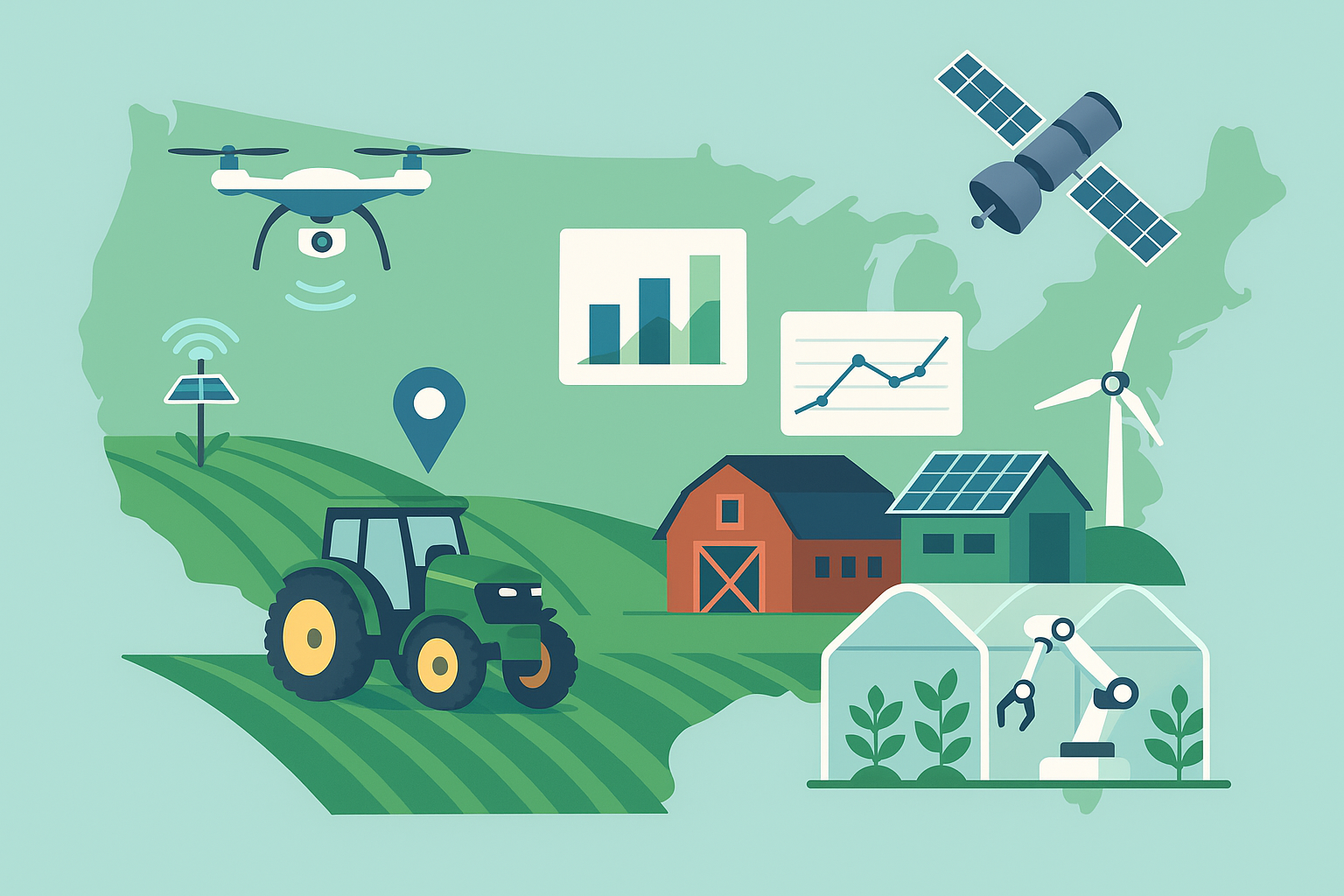
At Field Speed: On-the-Go Soil Sensing Powers Closed-Loop, Variable-Rate Agronomy

On-the-go soil sensors mounted on planters map soils in real time, calibrated with lab cores to guide variable-rate seeding, nitrogen, lime, and planter downforce. Fusing EC/EMI, vis–NIR, gamma, and compaction data improves input efficiency, yield stability, and sustainability, with payback in 1–3 seasons despite moisture, residue, and calibration challenges.

Tech

U.S. Agriculture Policy: Seven-Day Outlook on Funding, Farm Bill Talks, and Regulatory Moves

U.S. farm policy this week centers on securing funding, negotiating farm-nutrition packages, and clarifying environmental, water, and trade rules. Expect congressional oversight, draft text, USDA and EPA updates, and trade signals. Producers watch crop insurance, conservation enrollments, compliance guidance, biofuels incentives, and export data shaping risk management and planting decisions.

Politics
Storms, Suffrage, and the Seasonal Pulse: August 26 in U.S. Agriculture

Storms, Suffrage, and the Seasonal Pulse: August 26 in U.S. Agriculture

August 26 marks agriculture’s crossroads: Hurricane Andrew (1992) and Harvey (2017) exposed vulnerabilities from cane to cotton and spurred resilience: anchored storage, hardened infrastructure, insurance reforms, and emergency tools. The 19th Amendment’s certification broadened rural leadership. Late August remains a high-risk window, underscoring preparedness, layered risk management, and inclusive representation.

U.S. Farm Weather: Late-August Heat, Scattered Storms, and a 7-Day Regional Outlook

U.S. Farm Weather: Late-August Heat, Scattered Storms, and a 7-Day Regional Outlook

U.S. farm weather features persistent late-summer heat in the Southern Plains and Delta, with spotty storms elsewhere. The Corn Belt sees on-and-off thunderstorm clusters aiding grain fill but risking lodging; Northern Plains mostly favorable harvest windows with breezy fronts. Southwest monsoon storms bring localized flash flooding, while California’s Central Valley stays hot and dry. The Pacific Northwest remains largely dry and breezy with fire danger. Southeast and Florida maintain daily storms; the Northeast turns drier after a front. Tropical systems may alter late-week rain. Key hazards: heat stress, severe storms, flash floods, and fire weather. Confidence varies.

U.S. Ag Policy Briefing: Last 24 Hours and the 7-Day Outlook

U.S. Ag Policy Briefing: Last 24 Hours and the 7-Day Outlook

Late-August ag policy shifts from Congress to agencies and states, with potential USDA disaster designations, trade/access signals, and court actions. The week ahead centers on Monday’s Crop Progress, Federal Register notices, mid‑week USDA guidance and trade updates, Thursday’s Export Sales and comment deadlines, and late‑week filings or disaster declarations, plus weekend state‑fair statements. Key lanes: appropriations, farm programs and conservation, trade and supply chains, regulation/litigation, and disaster readiness. Producers should adjust marketing, monitor compliance changes, document weather impacts, and scan grants/NOFOs. Verify developments via USDA, Federal Register, USTR, FEMA, and committee sites.

US Macro & Markets: Jackson Hole Recap and Week Ahead — PCE, GDP, Durable Goods, Treasury Auctions (Aug 25–31, 2025)

US Macro & Markets: Jackson Hole Recap and Week Ahead — PCE, GDP, Durable Goods, Treasury Auctions (Aug 25–31, 2025)

With US cash markets closed, the weekend was quiet as investors parsed Jackson Hole signals on the Fed’s path. The coming week is data-heavy: July PCE inflation and personal spending, Q2 GDP (second estimate), July durable goods, August Consumer Confidence, weekly jobless claims, and mid-week Treasury auctions. Key risks include the Fed’s reaction to inflation progress, labor-market cooling, hurricane-season energy volatility, and thin month-end liquidity. Market focus: whether data sustain a soft-landing. Hotter PCE could lift yields and the dollar; cooler prints support duration and risk assets. Watch curves, breakevens, the dollar, oil, and credit spreads.

August 24 in U.S. Agriculture: Storms, Shocks, and Safeguards

August 24 in U.S. Agriculture: Storms, Shocks, and Safeguards

On August 24, U.S. agriculture has repeatedly hit turning points: 1992’s Hurricane Andrew devastated South Florida’s nurseries and tropical fruit sector, spurring insurance uptake and policy reforms; 1857’s Ohio Life failure triggered the Panic, collapsing grain prices and credit; 1912’s creation of the Alaska Territory enabled research and settlement that seeded today’s niche northern farming; and 2010’s massive Salmonella-linked egg recall tightened biosecurity and traceability. Together, these episodes highlight how weather, finance, governance, and food safety shape farm resilience.

On This Day in U.S. Agriculture: Andrew’s Landfall, the 1857 Panic, and the Patent Office Spared

On This Day in U.S. Agriculture: Andrew’s Landfall, the 1857 Panic, and the Patent Office Spared

On August 24, pivotal moments reshaped U.S. agriculture: in 1992, Hurricane Andrew ravaged South Florida’s nurseries, tropical fruit, and vegetables, spurring stronger structures, risk management, and insurance reforms; in 1857, the Ohio Life collapse triggered a panic that crushed grain prices and credit, tying farm fortunes to finance and trade; and in 1814, the Patent Office’s survival preserved agricultural innovation. Together, they underscore today’s priorities—climate resilience, financial preparedness, and sustained R&D—to protect production, markets, and labor across vulnerable specialty-crop and commodity regions.

U.S. Corn Market – 24‑Hour Summary & 7‑Day Outlook

U.S. Corn Market – 24‑Hour Summary & 7‑Day Outlook

U.S. corn futures were mixed over the last 24 hours, with September contracts closing at $3.83/bu and December slightly higher at $4.06½/bu. Prices remain under pressure from record projected production of 16.7 billion bushels, though hot, dry Midwest weather could limit yield gains. Export demand is steady but faces competition from Brazil’s large crop. Market sentiment is cautious, with funds holding significant short positions. Over the next week, weather will be the key driver; continued dryness could support prices, while improved rainfall may push futures lower.

U.S. Ag Weather: Southern Heat, Plains/East Storms, Dry West — 24-Hour Snapshot & 7-Day Outlook

U.S. Ag Weather: Southern Heat, Plains/East Storms, Dry West — 24-Hour Snapshot & 7-Day Outlook

Late-summer U.S. ag weather features persistent heat across the Southern Plains, Delta, Southeast, California’s Central Valley and Southwest deserts, while scattered thunderstorms along frontal zones affect the Plains, Midwest, Northeast, and daily sea-breeze/monsoon convection hits the Southeast and Four Corners. The West stays largely dry. Expect variable fieldwork windows, localized heavy rain, gusty winds, and brief flooding; disease pressure rises in corn/soy and cotton/peanuts. Risks include heat stress, episodic wind/hail, and intermittent wildfire smoke. Plan irrigation for high ET in the West, target post-frontal windows, protect livestock, and monitor National Hurricane Center updates.