Software & Web Development

Data Science & Robotics Development

Calc LLC provide high quality services at very competitive rate

Late‑Winter U.S. Ag Weather Outlook: National Summary, Regional Impacts, and 7‑Day Hazards

Late‑Winter U.S. Ag Weather Outlook: National Summary, Regional Impacts, and 7‑Day Hazards

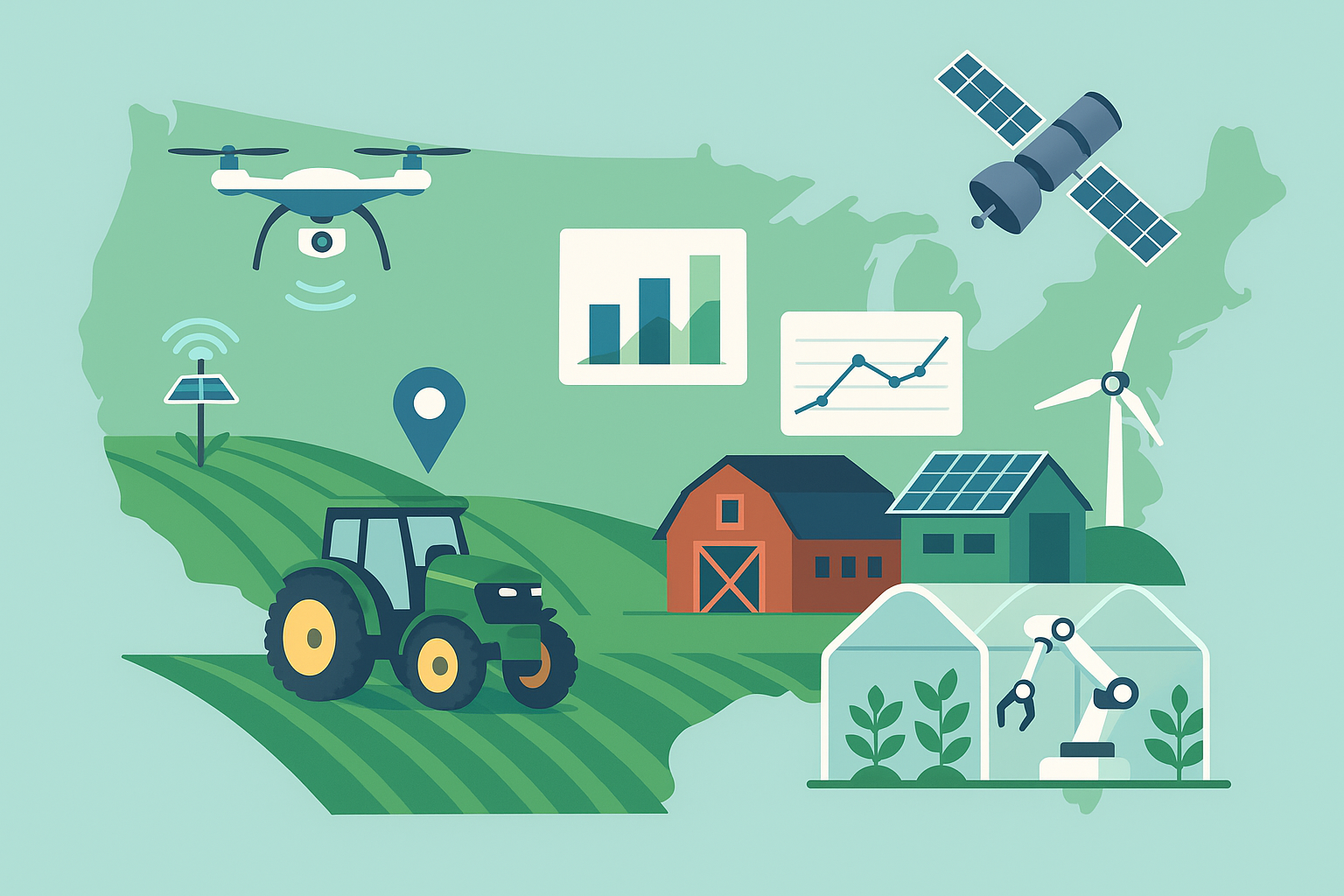
Late-winter U.S. agriculture faces rapid swings: intermittent rain/snow, brisk post-frontal winds, and patchy frost from the Southeast to western valleys. Fieldwork windows are short and regional. Watch West Coast storm-track pulses, Gulf-front showers/storms, and Southern High Plains fire weather. Protect blooming crops and livestock; consult local NWS forecasts.

Weather

At Field Speed: On-the-Go Soil Sensing Powers Closed-Loop, Variable-Rate Agronomy

On-the-go soil sensors mounted on planters map soils in real time, calibrated with lab cores to guide variable-rate seeding, nitrogen, lime, and planter downforce. Fusing EC/EMI, vis–NIR, gamma, and compaction data improves input efficiency, yield stability, and sustainability, with payback in 1–3 seasons despite moisture, residue, and calibration challenges.

Tech

U.S. Agriculture Policy: Seven-Day Outlook on Funding, Farm Bill Talks, and Regulatory Moves

U.S. farm policy this week centers on securing funding, negotiating farm-nutrition packages, and clarifying environmental, water, and trade rules. Expect congressional oversight, draft text, USDA and EPA updates, and trade signals. Producers watch crop insurance, conservation enrollments, compliance guidance, biofuels incentives, and export data shaping risk management and planting decisions.

Politics
Quiet Levers, Big Stakes: Drafts, Dockets, and Data Steering U.S. Agriculture Policy Now

Quiet Levers, Big Stakes: Drafts, Dockets, and Data Steering U.S. Agriculture Policy Now

U.S. agriculture’s last day featured quiet but pivotal work: farm-bill tradeoffs over commodity supports, conservation funding, and SNAP; agency capacity; labor costs; trade and input rules; livestock competition policy; and clean-fuel guidance. Stakeholders lobby as data and dockets shape near-term signals that will guide 2026 planting, investment, and market decisions.

Green Light for Farm Co-ops: The Capper–Volstead Act of 1922

Green Light for Farm Co-ops: The Capper–Volstead Act of 1922

On Feb. 18, 1922, Harding signed the Capper–Volstead Act, granting farmers limited antitrust protection to form cooperatives, coordinate marketing, and build scale under USDA oversight. It transformed agriculture while setting governance limits. Also on Feb. 18: 1930 cow flight/milking, 1939 Golden Gate Expo farm showcase, 1979 D.C. tractorcade snow rescues.

U.S. Agricultural Weather Outlook: Late‑Winter Regional Impacts and 7‑Day Fieldwork Windows

U.S. Agricultural Weather Outlook: Late‑Winter Regional Impacts and 7‑Day Fieldwork Windows

U.S. ag outlook: Intermittent precipitation and temperature swings dominate. PNW/Northern Rockies stay stormy; California sees light events; Southwest deserts mostly dry. Plains and Midwest fluctuate with fronts and mixed precip; Delta/Southeast get frequent showers; Northeast alternates rain/snow. Expect short fieldwork windows, muddy conditions, occasional frost, livestock stress, and fire-weather risks.

Soil-Powered Sensors: Harvesting Microbial Energy for Long-Lived Farm Monitoring

Soil-Powered Sensors: Harvesting Microbial Energy for Long-Lived Farm Monitoring

Soil-powered sensors using microbial fuel cells harvest microbes’ electricity to run low-power probes tracking moisture, temperature, salinity, and redox. They reduce battery maintenance, thrive under canopy, and integrate via LoRaWAN. Performance varies with soil conditions; smart firmware adapts. Pilots show competitive costs, multi-season life, and irrigation, salinity, and soil-health insights.

The Real Action in U.S. Ag Policy: 24-Hour Update and 7-Day Outlook

The Real Action in U.S. Ag Policy: 24-Hour Update and 7-Day Outlook

U.S. ag policy shifts daily through committee calendars, USDA implementations, Federal Register filings, court actions, trade/biofuels signals, and fast-moving state bills. Key themes: farm income and risk tools, conservation, pesticide certainty, labor rules, trade diversification, and biofuels demand. Producers should monitor dockets and data to guide planting, credit, and marketing.

Market Crosscurrents: Data-Dependent Fed, Sticky Services Inflation, and a Catalyst-Driven Week Ahead

Market Crosscurrents: Data-Dependent Fed, Sticky Services Inflation, and a Catalyst-Driven Week Ahead

Markets balanced restrictive policy with uneven disinflation and earnings dispersion. Front-end rates and dollar track data; equities rotate with narrow breadth; credit steady but selective; oil/gold follow macro and yields. Fed remains data-dependent. Upcoming catalysts—inflation, labor, housing, Treasury supply, earnings—may drive choppy, catalyst-driven trading and shifting leadership.

February 17: Four Turning Points That Shaped U.S. Agriculture

February 17: Four Turning Points That Shaped U.S. Agriculture

Across U.S. history, February 17 marks turning points in agriculture: Jefferson’s agrarian ascendancy (1801), the Civil War’s blow to plantation economies (1865), ARRA’s rural infrastructure surge (2009), and Winter Storm Uri’s resilience reckoning (2021), together redefining land, labor, connectivity, and risk in the U.S. food system.

Post‑Presidents Day Playbook: The Week Ahead in U.S. Agriculture Policy (Feb 16–22, 2026)

Post‑Presidents Day Playbook: The Week Ahead in U.S. Agriculture Policy (Feb 16–22, 2026)

Presidents Day paused action, but stakeholders sharpened positions on farm safety nets, conservation, H‑2A labor, biofuels credits, pesticides/water, livestock competition, trade, and nutrition. Expect a compressed Tuesday–Friday burst of rules, hearings, and guidance shaping risk management, compliance, revenues, and market access; producers should monitor Federal Register and committee notices.