Software & Web Development

Data Science & Robotics Development

Calc LLC provide high quality services at very competitive rate

Early May 2026 U.S. Ag Weather Outlook and Field Guidance

Early May 2026 U.S. Ag Weather Outlook and Field Guidance

Early May U.S. ag weather remains variable: scattered, brief storms across Plains, Corn Belt, and Mid-South amid warm, humid South; mostly dry California and Desert Southwest; periodic light precip Pacific Northwest. Expect alternating fieldwork windows with breezy days; localized severe, flooding, and fire risks; monitor disease, irrigation, and heat stress.

Weather
Cold Plasma Comes to the Farm: Cleaner Seeds, Safer Produce, and Nitrogen from Air

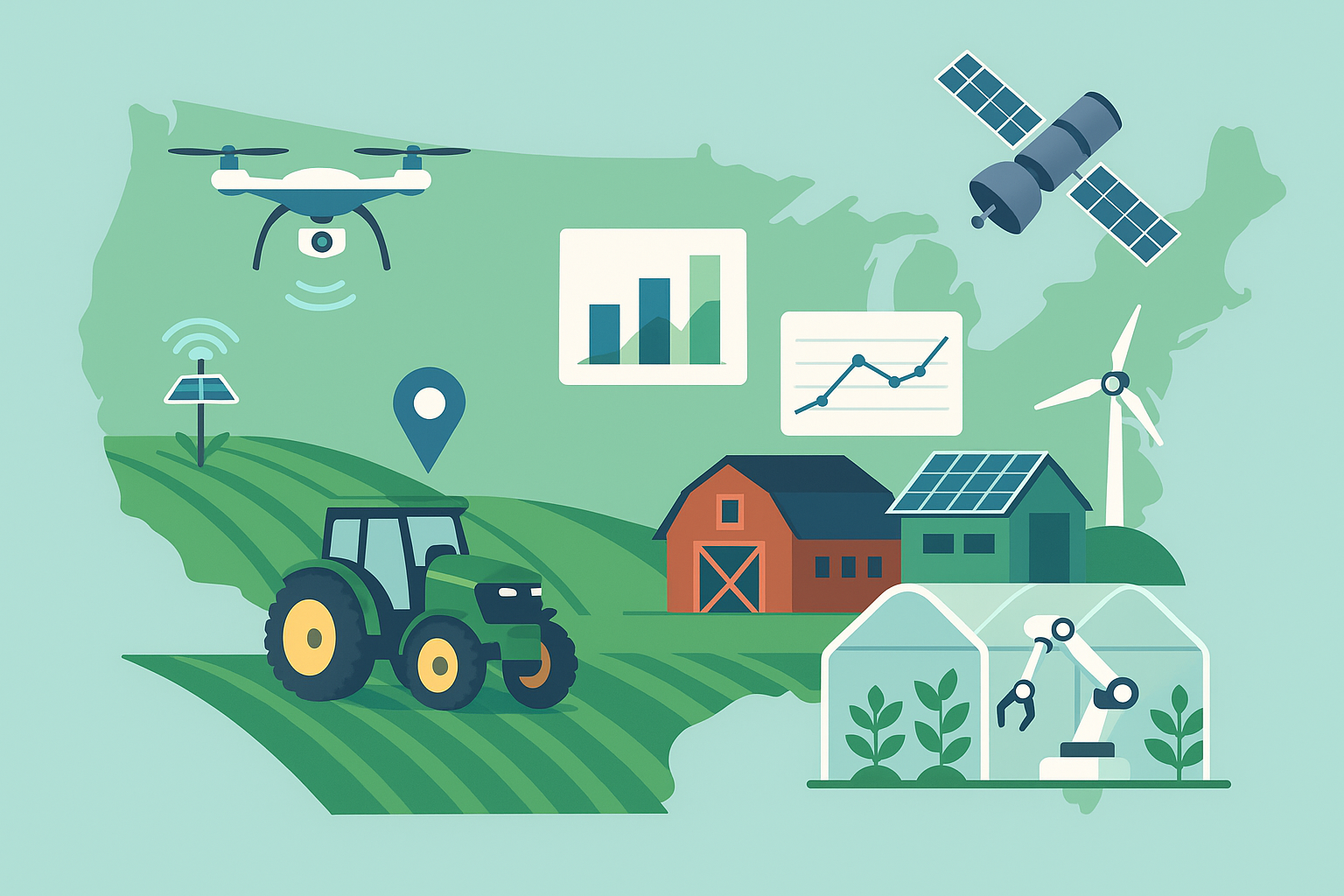
Cold plasma, a room-temperature ionized gas, offers farms residue-free seed priming and sanitization, produce disinfection, plasma-activated water, and on-site nitrate production from air. Benefits include reduced chemicals, water, and logistics; modular, renewable-ready hardware. Success depends on dose control, uniform exposure, energy efficiency, and validation, with smarter, integrated systems improving ROI.

Tech

Quiet Moves, Big Stakes: Incremental Budget and Rulemaking Steps Are Steering U.S. Agriculture This Week

U.S. ag policy saw positioning, not headlines, across budgets, USDA/EPA rules, biofuels credits, labor, water, and interstate standards. Stakeholders pressed for clarity on timelines, funding, and compliance. Expect incremental notices and guidance shaping planting, contracts, and investments; monitor pesticide/ESA, animal health, and trade risks as appropriations and rulemakings advance.

Politics
Soil-Powered Sensors: Harvesting Microbial Energy for Long-Lived Farm Monitoring

Soil-Powered Sensors: Harvesting Microbial Energy for Long-Lived Farm Monitoring

Soil-powered sensors using microbial fuel cells harvest microbes’ electricity to run low-power probes tracking moisture, temperature, salinity, and redox. They reduce battery maintenance, thrive under canopy, and integrate via LoRaWAN. Performance varies with soil conditions; smart firmware adapts. Pilots show competitive costs, multi-season life, and irrigation, salinity, and soil-health insights.

The Real Action in U.S. Ag Policy: 24-Hour Update and 7-Day Outlook

The Real Action in U.S. Ag Policy: 24-Hour Update and 7-Day Outlook

U.S. ag policy shifts daily through committee calendars, USDA implementations, Federal Register filings, court actions, trade/biofuels signals, and fast-moving state bills. Key themes: farm income and risk tools, conservation, pesticide certainty, labor rules, trade diversification, and biofuels demand. Producers should monitor dockets and data to guide planting, credit, and marketing.

Market Crosscurrents: Data-Dependent Fed, Sticky Services Inflation, and a Catalyst-Driven Week Ahead

Market Crosscurrents: Data-Dependent Fed, Sticky Services Inflation, and a Catalyst-Driven Week Ahead

Markets balanced restrictive policy with uneven disinflation and earnings dispersion. Front-end rates and dollar track data; equities rotate with narrow breadth; credit steady but selective; oil/gold follow macro and yields. Fed remains data-dependent. Upcoming catalysts—inflation, labor, housing, Treasury supply, earnings—may drive choppy, catalyst-driven trading and shifting leadership.

February 17: Four Turning Points That Shaped U.S. Agriculture

February 17: Four Turning Points That Shaped U.S. Agriculture

Across U.S. history, February 17 marks turning points in agriculture: Jefferson’s agrarian ascendancy (1801), the Civil War’s blow to plantation economies (1865), ARRA’s rural infrastructure surge (2009), and Winter Storm Uri’s resilience reckoning (2021), together redefining land, labor, connectivity, and risk in the U.S. food system.

Post‑Presidents Day Playbook: The Week Ahead in U.S. Agriculture Policy (Feb 16–22, 2026)

Post‑Presidents Day Playbook: The Week Ahead in U.S. Agriculture Policy (Feb 16–22, 2026)

Presidents Day paused action, but stakeholders sharpened positions on farm safety nets, conservation, H‑2A labor, biofuels credits, pesticides/water, livestock competition, trade, and nutrition. Expect a compressed Tuesday–Friday burst of rules, hearings, and guidance shaping risk management, compliance, revenues, and market access; producers should monitor Federal Register and committee notices.

Holiday Lull Ends: Data-Heavy Week to Test Soft-Landing and Fed Easing Timeline

Holiday Lull Ends: Data-Heavy Week to Test Soft-Landing and Fed Easing Timeline

With U.S. markets shut for Presidents Day, liquidity was thin and price discovery deferred to Tuesday. Investors now watch inflation-versus-growth signals, Fed minutes, housing, PMIs, jobless claims, earnings, and Treasury auctions. Outcomes will steer front-end rates, dollar, curve shape, equity leadership, credit spreads, and post-holiday flows.

February 16 in U.S. Agriculture: Safety Nets, Shocks, and the Long Arc of Adaptation

February 16 in U.S. Agriculture: Safety Nets, Shocks, and the Long Arc of Adaptation

Across decades, February 16 brought events reshaping U.S. agriculture: 1938 farm policy and crop insurance foundations; 1899 freeze relocating Florida citrus; César Chávez’s 1968 fast elevating farmworker rights; 2015 port snarls exposing logistics risks; Kyoto’s 2005 ripple effects; and 2021’s Uri freeze—underscoring links among policy, climate, labor, markets, and resilience.

Holiday‑Shortened Week Puts FOMC Minutes, Housing, and Retail Signals in Focus

Holiday‑Shortened Week Puts FOMC Minutes, Housing, and Retail Signals in Focus

With U.S. markets closed Monday, thin liquidity left positioning in focus. FOMC minutes, housing data, retailer earnings, jobless claims, and Treasury supply anchor a compressed week. Base case favors a soft landing; key risks are sticky inflation or weakening labor, shaping rates, equity leadership, credit spreads, and dollar direction.