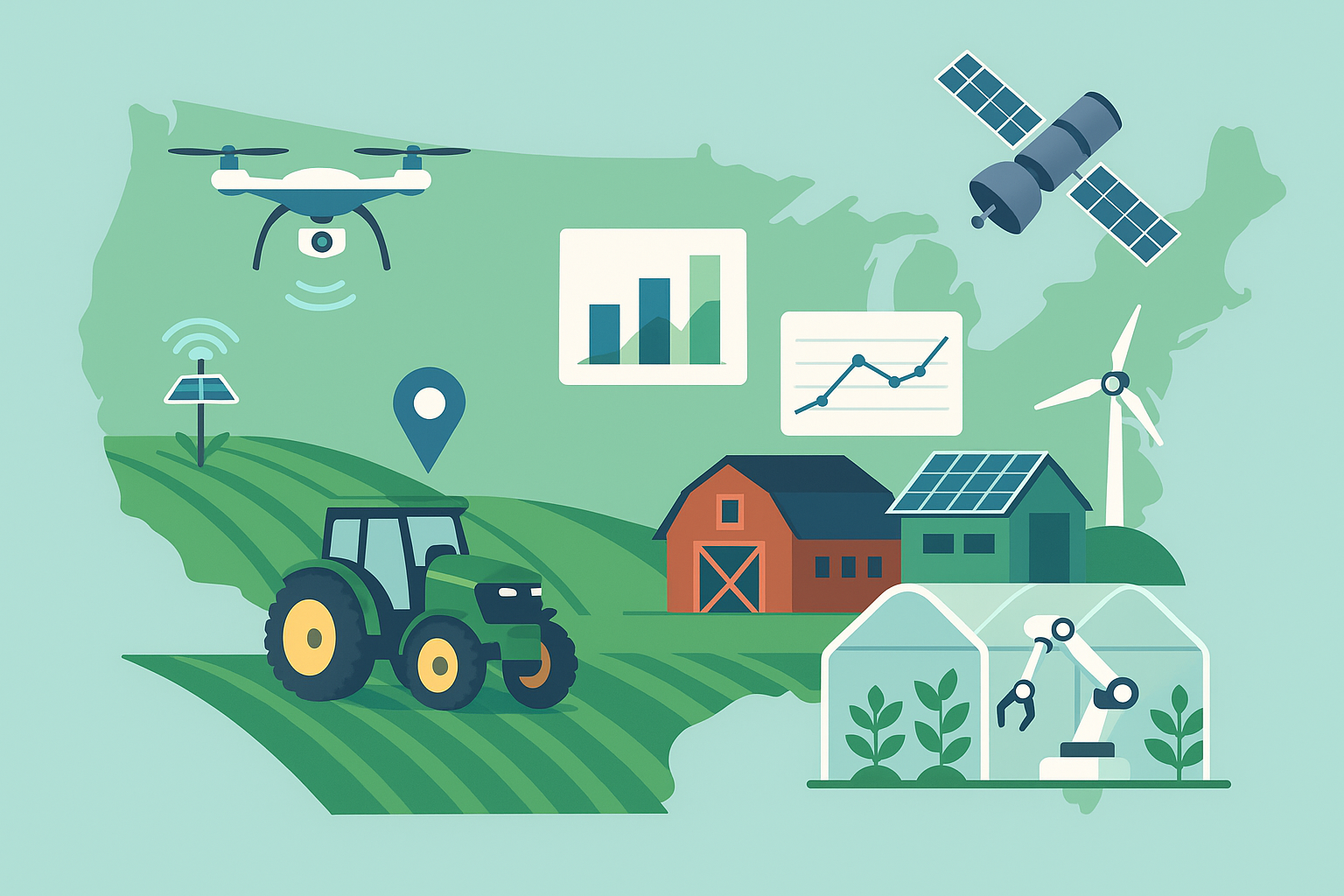
Across farms worldwide, the promise of Internet-connected soil sensors has collided with a stubborn constraint: power. Batteries add cost, labor, and waste; solar panels struggle under canopy cover, dust, and shade. A quiet but consequential alternative is moving from research plots into commercial pilots—soil-powered sensors that harvest electricity from the microbiology already living in the ground. By tapping the tiny currents generated as microbes break down organic matter, these devices aim to monitor moisture, temperature, salinity, and redox conditions for years with little to no battery maintenance.
How soil-powered sensors work
The underlying engine is a microbial fuel cell (MFC), an arrangement of two electrodes placed in moist soil. Microorganisms at the anode oxidize organic compounds, releasing electrons that travel through a circuit to a cathode, creating a small but continuous electric current. Typical outputs are measured in tens to a few hundreds of microwatts at a fraction of a volt. Energy-harvesting chips boost and store that trickle in a supercapacitor. The sensor then wakes periodically—every hour, or a few times a day—collects readings, transmits data, and returns to an ultra-low-power sleep mode while the capacitor refills.
Because available energy and voltage are limited, the best-fit instruments are solid-state and frugal: soil moisture (dielectric-based), temperature, electrical conductivity (a proxy for salinity), oxidation–reduction potential (redox), and sometimes pH. Ion-selective measurements (like nitrate) are possible but typically require careful power budgeting, fewer transmissions, and robust calibration plans.
Why it matters on the farm
- Lower maintenance: Eliminating most battery swaps reduces truck rolls and labor, especially across large acreages or hard-to-reach blocks.
- Resilience under canopy: Unlike small solar panels, soil power is indifferent to shading by leaves or trellis systems.
- Less e-waste: Fewer spent batteries means a smaller environmental footprint and simpler compliance.
- More data, better timing: Reliable, season-long moisture and salinity trends support precise irrigation and fertigation decisions.
What the signals really mean
These devices don’t deliver an endless feed; they budget energy for the most actionable snapshots. Expect hourly to daily data cadences, which are sufficient for many agronomic tasks:
- Irrigation scheduling: Moisture curves help identify refill points, infiltration rates, and root-zone depletion—useful in orchards, vineyards, and row crops under drip or pivot.
- Salinity management: Electrical conductivity trends reveal salt accumulation in arid regions or under reclaimed water use, guiding leaching fractions and fertigation rates.
- Soil health indicators: Redox and temperature can flag anaerobic conditions after heavy rainfall or compaction events.
- Greenhouse and hoop houses: Stable microclimates and consistent moisture offer ideal conditions for low-power sensing without solar panels cluttering aisles.
Performance boundaries and how to plan around them
Power output depends on soil biology, moisture, temperature, and organic matter. In practice:
- Moist, biologically active soils produce more power than very sandy, cold, or dry soils. Frozen or severely dry conditions can pause energy generation.
- Typical energy budgets support multiple daily measurements and one or more LoRaWAN transmissions. High-frequency telemetry or power-hungry sensors may require local storage and less frequent uplinks.
- Electrode materials matter: Carbon-based electrodes are common due to stability and biocompatibility. Metals can corrode or drift electrically in certain chemistries.
Vendors address variability with smart firmware: adaptive sampling (slower in drought or cold), compressed data packets, and energy-aware scheduling that avoids “brownouts.” Gateways placed to minimize transmission power (e.g., shorter LoRaWAN hops) extend capability further.
Connectivity and data integration
Most deployments use low-bandwidth, long-range links such as LoRaWAN to cover fields with a modest number of gateways. In fringe cellular areas, a single gateway backhauls via 4G/LTE or satellite for entire farm blocks. On the software side, avoid lock-in by choosing platforms that export data via standard APIs (MQTT, HTTPS) and support common schemas, enabling fusion with weather data, irrigation logs, and yield maps.
Durability, calibration, and lifecycle
- Service life: Designs target multiple seasons; three to five years is a practical goal, depending on materials, soil chemistry, and handling.
- Sensor drift: Moisture and temperature are generally stable; EC, pH, and redox benefit from seasonal checks against lab samples. Some systems pair periodic in-situ reference checks with machine learning to adjust baselines.
- Sustainability: Biodegradable housings and inert electrode choices reduce end-of-life burdens. Confirm that encapsulants and cables avoid problematic additives for your jurisdiction.
How many nodes are enough?
Spatial variability rules here. As a starting point:
- Row crops on relatively uniform soils: 4–8 nodes per 40 hectares (100 acres), concentrated in distinct management zones.
- Orchards and vineyards: 1–2 nodes per block, with depth-specific probes near the main root zone and a second at leaching depth for salinity monitoring.
- High-value protected cultivation: 1 node per bay or per irrigation valve set.
Anchor the network with a short pilot: co-locate sensors with soil sampling and a pressure gauge or flow meter, then refine placement based on observed variability and water-use correlations.
Economics: what to expect
Costs vary by vendor, sensor suite, and connectivity. Early commercial units typically price in the same neighborhood as battery-powered peers, with the promise of lower total cost of ownership over time.
- Hardware: Often comparable to conventional multi-depth probes, with premiums for advanced chemistries (pH, redox).
- Network: One gateway can cover large acreages under LoRaWAN; spreading gateway cost over many nodes keeps per-acre expense modest.
- Operating: Savings accrue from avoided battery purchases and swap labor, fewer field visits, and reduced crop stress from better-timed irrigations.
Growers commonly target payback within one to three seasons via water savings, yield stabilization, or quality improvements—especially in water-constrained regions and high-value crops.
Alternatives and complements
- Battery-powered nodes: Mature, flexible, and proven; still dominant for high-frequency telemetry or power-hungry sensors.
- Solar micro-nodes: Strong where canopy is sparse and maintenance access is easy; dust and shading can degrade output.
- Other energy harvesters: Thermal or kinetic options exist but are less aligned with buried soil sensing.
- Remote sensing: Satellites and drones add spatial context; pairing them with ground nodes improves calibration and actionability.
Data stewardship and interoperability
As with any agtech, data ownership and portability deserve early attention. Verify contractual rights to raw and processed data, clarity on anonymization and sharing, and the ability to export historical records if you switch platforms. Favor systems compatible with open device registries and farm management software to future-proof investments.
Questions to ask vendors
- What is the expected measurement cadence under dry, cold, and saline conditions?
- Which sensors are included, and how is drift handled over multiple seasons?
- What materials are in the electrodes and housing, and how are they managed at end-of-life?
- Which connectivity options are supported (LoRaWAN, cellular backhaul, satellite) and what are the coverage assumptions?
- How is data secured from node to cloud, and what export formats/APIs are available?
- What field evidence exists for performance across my soil types and irrigation methods?
What to watch next
- Higher-efficiency energy harvesters and firmware that learn local energy budgets to optimize measurement timing.
- Flexible, carbon-based electrodes that improve contact with diverse soils and resist fouling.
- Calibration-light chemistries for nutrients, with machine learning correcting for temperature and ionic interferences.
- Native integrations with irrigation controllers for closed-loop scheduling under water allocation constraints.
- Programmatic incentives from water authorities and sustainability schemes that recognize reduced e-waste and improved efficiency.
Bottom line
Soil-powered sensors won’t replace every node on the farm, but they expand where continuous ground truth is practical—under canopy, far from roads, and across large, heterogeneous fields. By converting soil biology into dependable micro-power, they offer a pragmatic path to denser, longer-lived monitoring networks. For growers navigating tighter water budgets, input costs, and climate variability, that extra stream of timely data can be the difference between reactive fixes and proactive control.