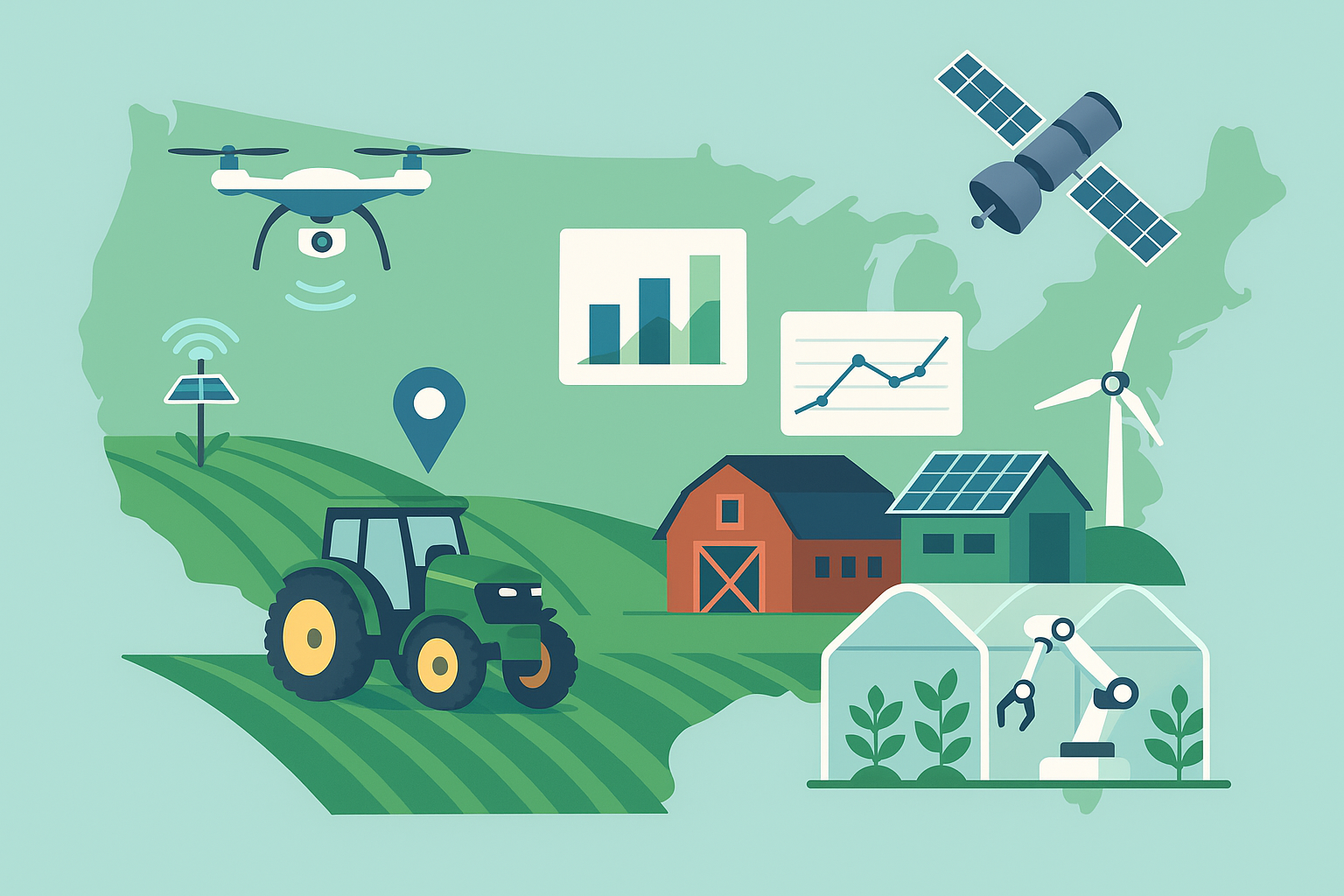
As planters and strip-till bars roll across spring fields, a quiet revolution is unfolding beneath the gauge wheels. Instead of relying solely on a handful of soil cores pulled weeks earlier, implements are increasingly outfitted with on-the-go soil sensors that read the ground in real time—and automatically adjust seed rate, fertilizer, and lime as conditions change row by row. The result is a faster, denser picture of the field, tighter input targeting, and a step toward true closed-loop agronomy.
What “on-the-go” soil sensing really means
On-the-go soil sensing refers to instruments mounted on farm machinery that measure soil properties continuously while the equipment moves. Unlike traditional sampling—collecting discrete cores and sending them to a lab—these systems create high-resolution maps at field speed. Common mounting points include planter frames, tines, coulters, or sleds pulled ahead of the tractor.
The goal isn’t to replace the lab outright. It’s to vastly increase spatial coverage and then “anchor” sensor readings to ground-truth samples through calibration. With this pairing, farmers can transition from a dozen data points per field to tens of thousands—enough detail to support variable-rate decisions on the fly.
The sensor toolbox, explained
Electrical conductivity and electromagnetic induction
Electrical conductivity (EC) tools pass a small current through shallow soil and measure resistance; electromagnetic induction (EMI) estimates similar properties via an induced magnetic field without direct contact. Both methods are rapid and robust, revealing variations in texture, salinity, moisture, and compaction proxies. They help delineate management zones and inform variable seed and nitrogen strategies.
Visible–near infrared (vis–NIR) spectroscopy
Vis–NIR units shine light (roughly 400–2,500 nm) into soil and read the reflected spectrum. The spectral “fingerprint” correlates with organic matter, clay content, carbonates, and, with careful calibration, pH and cation exchange capacity. Many planter-mounted vis–NIR heads scan the seed trench wall, which minimizes residue interference and captures the root-zone profile that matters most for establishment.
Gamma radiometrics
Passive gamma sensors measure naturally emitted radiation from isotopes such as potassium-40 and thorium/uranium series. These signals relate to parent material and texture at depths often beyond what EC senses, creating stable base maps that do not change with daily moisture. They are particularly useful for long-term zone delineation and soil survey refinement.
Penetrometers, moisture, and temperature probes
Mechanical or acoustic penetrometers measure resistance, providing a compaction profile. Coupled moisture and temperature probes add context for germination risk and nitrogen mineralization potential. Together, these sensors improve planter setup (downforce, closing action) and help avoid overpopulating seeds in drought-prone bands.
From raw signals to agronomy-grade maps
Raw sensor outputs are not agronomy by themselves; they become useful through calibration and modeling:
- Ground-truthing: Statistically representative soil cores are collected along the sensor transects and analyzed by a lab for benchmarks like organic matter, texture, and pH.
- Modeling: Techniques such as partial least squares regression (for spectroscopy), random forests, or Gaussian processes relate sensor readings to lab values. Moisture confounding is controlled via physics-based adjustments or multi-sensor fusion.
- Resolution and smoothing: Final maps typically resolve at 5–20 meters depending on speed, sensor footprint, and field conditions, with geostatistical smoothing to avoid overfitting to wheel tracks or residue patches.
- Prescriptions: The calibrated layers feed variable-rate seed, nitrogen, and lime scripts that follow pre-agreed agronomic rules or optimization models.
What changes on the planter—and in the crop
Variable-rate seeding that tracks soil potential
Texture and organic matter maps help match plant density to water and nutrient supply. In drought-prone sands, dropping seeding rates curbs stress and lodging; in loamy benches, bumping density captures yield potential. On corn, many growers target 2,000–8,000 seed swings across zones; in soybeans, 30,000–120,000 plants per acre swings are common, depending on row spacing and disease risk.
Smarter nitrogen and lime
Organic matter and texture influence mineralization and leaching. In-season nitrogen sidedress can be tapered where OM is high or soils are prone to denitrification, while sandier sections get more, timed closer to uptake. For pH, variable-rate lime is one of the earliest and most consistent ROI use cases: spectroscopic carbonate and EMI/texture layers refine lime demand and spreading patterns, often cutting material in already neutral zones and addressing acid hotspots more precisely.
Planter setup as a moving target
Compaction and moisture sensors can drive automatic downforce and closing-wheel adjustments. In lighter ground, the planter backs off to preserve structure; in heavier bands, it leans in to secure depth consistency. Better emergence uniformity translates directly into yield stability, especially in corn.
Economics: where the payback comes from
Return on investment depends on crop, input prices, and field variability, but growers typically cite three payback pathways:
- Input efficiency: 5–15% nitrogen savings are common when layering on-the-go sensing with agronomic rules, with comparable reductions in lime where over-application was occurring.
- Yield stability: Variable seeding that matches soil potential limits overpopulation in weak zones and underpopulation in strong ones, tightening tails on yield distribution rather than only chasing top-end.
- Time and labor: One pass can collect acres of sensor data during normal planting or tillage, reducing preseason soil sampling labor and contractor costs.
Across mixed fields, breakeven often arrives within 1–3 seasons, faster when fertilizer prices are high or when variability is large.
Environmental gains, quantified
Placing N where it will be used reduces nitrate leaching and nitrous oxide emissions. More precise liming stabilizes pH, improving nutrient use efficiency and reducing heavy metal mobility. High-density organic matter mapping also supports soil carbon programs by improving the representativeness of verification sampling and tracking changes at zone scale. Together, these benefits align with retailer and processor sustainability targets without forcing growers to adopt unfamiliar crops or radical rotations.
Limitations and how practitioners address them
- Moisture confounding: Spectra and EC shift with moisture. Best practice pairs data collection with moisture sensors and applies correction models, or collects basemaps in stable moisture windows.
- Residue and trash: Optical heads must “see” soil. Trench-mounted optics, residue managers, and air-knife cleaning mitigate fouling; operators still need to inspect optics daily.
- Local calibration drift: Models trained in one region can misbehave in another due to mineralogy differences. Periodic local cores and adaptive modeling keep errors in check.
- Data overwhelm: Multiple layers can confuse decision-making. Many teams start with two or three proven layers—texture/EC, OM, and pH proxy—before adding complexity.
Standards, connectivity, and the “closed loop”
For on-the-go sensing to act in real time, machine control must speak the same language as the sensor. ISOBUS compatibility and farm data formats (e.g., ISO-XML, shapefile, and newer task data standards) are steadily improving. Edge compute modules on the implement now run calibration models locally and push only cleaned, compressed layers to the cab display and cloud. That means a sensor can see a higher-clay band, the controller can reduce seeding rate, and the as-applied map can log the change—without a cellular connection.
Case snapshots from the field
- Acid knolls, precise lime: A 1,200-acre grower identified low-pH knolls invisible to low-density sampling. Variable-rate lime cut total tonnage by 18% while lifting soybean yield 2–4 bu/ac on corrected knolls.
- Sand veins, right-rate seed: A corn-on-corn operation used EC and OM layers to drop 4–6k plants/ac on sand veins and add 2–3k on loams. Stand uniformity improved, and drought-year losses were muted by reduced competition in the sands.
- N timing, less loss: A sidedress bar tied to OM and moisture maps shifted 20–30% of N from preplant to V6–V8 in leach-prone zones, trimming total N 8% with no yield penalty in a wet spring.
What’s next: fusion, depth, and democratization
Three arcs are shaping the next wave:
- Sensor fusion: Combining EC/EMI, vis–NIR, gamma, and penetrometer data in unified models reduces uncertainty and lowers the need for frequent recalibration. Multi-depth sleds add a vertical profile for rooting and water storage insights.
- Real-time control: Seed meters, liquid valves, and downforce stacks are increasingly tied directly to sensor outputs, moving from map-following to sensing-and-acting in the same pass.
- Access for smaller farms: Lower-cost sleds and subscription models that include calibration and agronomy support are broadening adoption beyond large row-crop operations and into specialty and smallholder systems.
Practical starting points
For operations considering the jump:
- Begin with a basemap pass using EC/EMI plus a moisture-corrected OM layer; use it to refine variable-rate lime and a simple two- or three-zone seeding plan.
- Pull targeted soil cores inside each zone the first season to lock in calibration and validate decisions.
- Integrate planter downforce automation and as-applied logging to close the loop on emergence and early vigor.
- Expand to in-season nitrogen adjustments once confidence in the baseline maps is high.
The bottom line
On-the-go soil sensing turns every acre of field time into a data collection pass and every sensor ping into a chance to optimize. When anchored to smart calibration and agronomic rules, it shifts precision agriculture from a planning exercise to a responsive system—one that allocates seed, nutrients, and attention to where they will matter most. For growers juggling weather, input costs, and sustainability demands, that responsiveness is fast becoming a competitive edge.