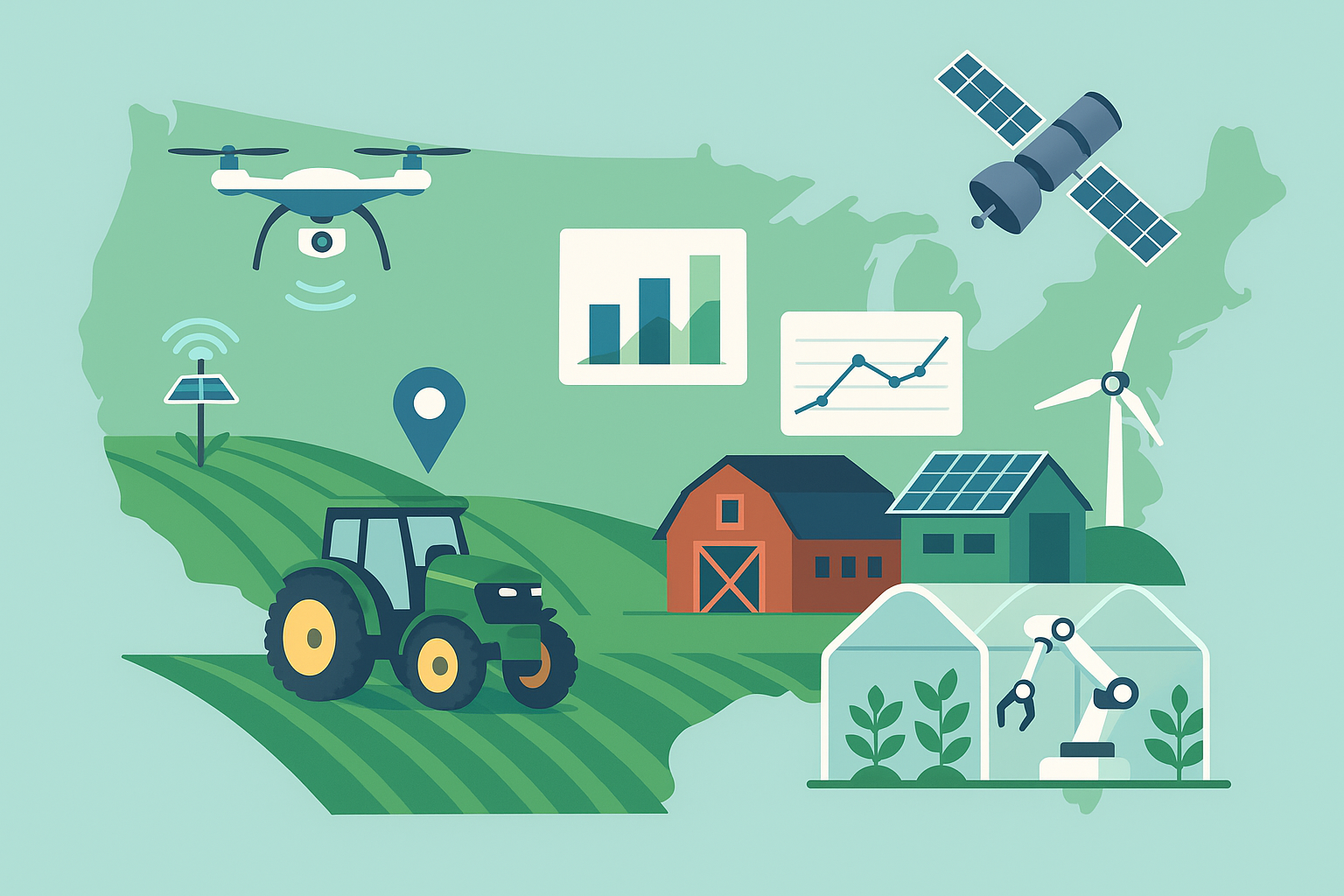
For years, “smart farming” meant bristling fields with weather stations, cameras, and mast-mounted radios. Yet the most important part of the farm—where water, nutrients, microbes, and roots meet—remained largely invisible to the network. That gap is closing as wireless underground sensor networks (WUSNs) move from research plots into commercial agriculture, burying low-power radios and multi-parameter probes in the soil profile to stream data that above-ground devices can’t reach.
By placing connectivity and sensing below the surface, growers can monitor the root zone directly, automate irrigation with far greater precision, and track fertilizer dynamics in real time—all while protecting equipment from weather, machinery, and vandalism. As of 2026, a small but growing cluster of startups, equipment makers, and research extensions are fielding WUSN systems designed specifically for seasonal row crops, orchards, vineyards, and protected agriculture.
What makes underground connectivity different
Soil is an unforgiving medium for radio. Water molecules absorb energy; salts increase conductivity and attenuation; compaction, texture, and even temperature shift how signals propagate. Conventional IoT devices optimize for air. WUSNs flip those assumptions, pairing soil physics with novel communications methods and packaging. The result isn’t just “IoT moved underground”—it’s a rethinking of how agriculture collects and uses subsurface intelligence at scale.
Key capabilities unlocked
- Root-zone visibility: Continuous moisture, temperature, conductivity (EC), oxygen, and sometimes nitrate or redox measurements at multiple depths (e.g., 10–60 cm) where roots actually uptake water and nutrients.
- Protected infrastructure: Electronics and antennas live below the plow layer or in permanent beds, shielded from UV, wind, and vandalism; fewer mast installs and cable runs.
- Fine-grained control: Data feed directly into variable-rate irrigation (VRI), fertigation, and scheduling models, enabling tighter set points and zone-by-zone decisions.
- Season-long stability: Buried nodes are less prone to intermittent connectivity than surface devices buffeted by canopy movement and weather.
How WUSNs work
WUSNs typically follow a three-layer architecture: underground nodes with sensors and local radios, near-surface or canopy relays, and a gateway that uplinks to the cloud via cellular or farm Wi‑Fi. The underground nodes talk to each other and/or to relays using techniques tuned for the soil environment.
Radio options for soil
- Sub-GHz narrowband and chirp spread spectrum: Bands such as 433 MHz or 868/915 MHz are favored because longer wavelengths penetrate better. Chirp spread spectrum increases resilience to attenuation and multipath. Data rates are modest but sufficient for sensor telemetry.
- Magnetic induction (MI): Instead of radiating electromagnetic waves, nodes couple via quasi-static magnetic fields generated by coils. MI attenuates less in conductive media and can sustain short hops between buried nodes or to a shallow relay, albeit with tight range constraints.
- Hybrid approaches: A buried node may use MI for the few tens of centimeters to a surface puck, which then relays via LoRa, BLE, or 802.15.4 over air to a gateway. This blend balances low-loss underground coupling with established surface networks.
Power and endurance
Because digging up soil to swap batteries is costly, power management defines WUSN design. Common strategies include:
- Primary cells with decade chemistry: Lithium thionyl chloride packs offer high energy density and low self-discharge for multi-season deployments when paired with aggressive sleep schedules.
- Energy harvesting: Microbial fuel cells leverage redox gradients between anaerobic soil and an above-ground cathode; thermoelectric generators harvest diurnal temperature swings; small, near-surface solar pucks trickle-charge supercaps. These methods often support low-duty-cycle nodes or extend battery life.
- Edge compression and event-driven sampling: Nodes store high-frequency measurements locally, transmitting summaries, anomalies, or threshold crossings to conserve energy and airtime.
Packaging for the underground
Electronics are potted in elastomers or epoxy for ingress protection, while sensor interfaces use specialized windows:
- Porous ceramic or polymer membranes for ion-selective electrodes (e.g., nitrate, ammonium), designed to remain hydrated and minimize drift.
- Ruggedized stainless or composite probes for water potential (tension), dielectric moisture, and temperature, optimized for minimal soil disturbance.
- Anti-fouling and anti-biofilm coatings prolong accuracy in biologically active soils.
From data to decisions
Raw numbers don’t irrigate fields—algorithms do. WUSN data become valuable when they drive operational set points, closed-loop control, and verification of outcomes.
Irrigation automation
Instead of watering by calendar or weather alone, growers can set soil-moisture or water-potential thresholds by crop stage and soil type. The controller opens valves or adjusts pivot speed when and where the root zone nears stress, and stops when target ranges recover. Because the sensors live at depth, the system detects whether water actually reached the roots, reducing overwatering and runoff.
Nutrient management
Ion-selective electrodes and EC trends hint at nitrogen and salinity movement down the profile. Coupled with fertigation logs and weather, WUSNs can flag leaching risk events, guide spoon-feeding strategies, and verify whether applied nutrients remain in the effective root zone.
Soil health and risk monitoring
- Oxygen and redox: Warn of anaerobic conditions in heavy or waterlogged soils.
- Temperature profiles: Support frost mitigation in orchards and greenhouses; inform biological activity models.
- Salinity dynamics: Track salt buildup in drip zones and evaluate leaching irrigation effectiveness.
Underground measurements anchor the “digital twin” of the soil profile, letting farms shift from inferred to observed water and nutrient movement.
Deployment patterns that work
There is no one-size-fits-all layout. Effective WUSNs match the field’s hydrology, crop rooting patterns, and equipment traffic.
Depth and placement
- Row crops: Shallow nodes (10–20 cm) capture rapid wetting and evaporation; deeper nodes (30–60 cm) track storage and leaching. Place near, but not directly in, drip lines or fertigation emitters.
- Perennials: Multi-depth stacks in representative tree rows or vine blocks, positioned between emitters and trunk to capture typical wetting fronts.
- No-till and high-traffic zones: Bury below the disturbance layer and map locations precisely to avoid implement strikes.
Density and zoning
Start with a small number of “sentinel” stacks per management zone, expanding density where soils, slopes, or canopy vigor vary. Pair WUSNs with EM mapping, yield data, or drone imagery to delineate zones before installation.
Installation and lifecycle
- Tools: Use narrow augers or water injection to minimize soil structure disturbance. Backfill carefully to restore native bulk density around sensors.
- Commissioning: Calibrate moisture sensors to soil texture where possible; verify network links at target moisture extremes (dry/wet).
- Seasonality: In annual crops, consider semi-permanent installs along permanent beds or wheel tracks; in perennials, plan for multi-year service with maintenance windows post-harvest.
Performance, ROI, and what to expect
Performance depends on soil texture, salinity, and water table dynamics. In coarse, low-salinity soils, sub-GHz radios may reach tens of meters to a surface relay; in saline clays at field capacity, ranges can shrink dramatically, favoring MI or very short hops. Expect to pilot in a few zones before scaling.
Return on investment typically comes from three levers:
- Water savings through tighter irrigation set points and reduced runtime.
- Yield and quality stabilization by avoiding stress swings and improving uniformity across a block or pivot sector.
- Input and compliance benefits via more efficient fertigation and better documentation of stewardship (water use, nutrient fate).
Many farms already realize double-digit percentage water-use reductions with conventional soil sensors when integrated into scheduling. WUSNs extend that benefit by capturing what surface probes miss, particularly during heat waves, windy conditions, or in drip systems where wetting fronts move below the surface.
Where WUSNs fit—and where they don’t
Strong fit
- Drip- and micro-irrigated perennials where water and nutrient uniformity are paramount.
- High-value vegetables under plasticulture or protected systems where set points are tight and re-entry for maintenance is controlled.
- Pivots retrofitted with VRI where zone-specific data translate directly to nozzle control.
Challenging environments
- Highly saline, saturated clays where radio attenuation and sensor fouling are severe.
- Fields with deep mechanical tillage that would disrupt buried nodes each season.
- Short-season rotations where redeploying equipment multiple times a year erodes ROI.
Integration with other sensing modalities
WUSNs are not a replacement for other data—they’re the anchor point. Effective programs layer signals:
- Satellites and drones: NDVI/SAVI/thermal imagery highlight spatial variability and stress; WUSNs explain the “why” at root depth.
- Cosmic-ray neutron sensors: Provide field-scale soil moisture trends; WUSNs calibrate and localize them.
- EM induction and soil sampling: Map texture, salinity, organic matter; WUSNs monitor dynamics over time.
- Weather stations: Combine evapotranspiration forecasts with underground thresholds to optimize irrigation windows.
Security, spectrum, and standards
Because WUSNs often utilize unlicensed sub-GHz bands, spectrum planning matters in dense deployments. Look for devices that support adaptive data rates, channel hopping, and duty-cycle limits to coexist with neighboring farms. End-to-end encryption and device authentication are increasingly standard as more farm operations connect to enterprise systems.
Interoperability remains a work in progress. Emerging efforts focus on common data models for soil parameters, standardized calibration metadata, and device provisioning workflows that let mixed-vendor nodes join the same management platform. Until standards mature, integration via APIs and field gateways is the practical path.
Challenges still to solve
- Calibration drift and maintenance: Ion sensors can drift; dielectric probes require texture-specific calibration for best accuracy. Vendors that provide in-situ checks and simple field validation steps reduce uncertainty.
- Long-term reliability: Wet-dry cycling, swelling clays, and microbial growth stress seals and membranes. Multi-year warranties that explicitly cover burial conditions are a meaningful differentiator.
- Network planning: Modeling underground link budgets is nontrivial. Tools that simulate soil moisture scenarios and recommend relay placement lower deployment risk.
- Lifecycle and e-waste: Buried electronics shouldn’t become stranded trash. Retrieval plans and take-back programs matter for sustainability and regulatory compliance.
- Cost curve: Upfront spend is still higher than surface probes. Scale, simpler installs, and energy harvesting will be key to mainstream adoption.
Realistic buying checklist
- Soil and crop fit: Has the system been deployed in soils and crops like yours? Ask for documented performance across moisture and salinity extremes.
- Depth profile: Which depths are supported, and can stacks be customized per zone?
- Radio strategy: Sub-GHz, MI, or hybrid? What are the expected ranges at your soil EC and moisture levels?
- Power plan: Battery life under your sampling schedule; options for energy harvesting; service procedures when power is exhausted.
- Data model: How are moisture, EC, and ion readings calibrated to your soil? Are thresholds crop-stage aware? Can you export data into your existing irrigation controller or farm platform?
- Durability: Ingress protection rating, membrane materials, anti-fouling features, and warranty terms specific to burial.
- Installation and support: Who installs, how long it takes per node, and what tools are required. Is there a retrieval plan?
- Security and compliance: Encryption, device authentication, and spectrum compliance for your region.
- Total cost of ownership: Hardware, subscriptions, replacements, and any fees for integration or API access.
Case pattern: From pilot to control loop
A typical adoption path starts small. A grower selects two or three representative management zones, each with a stack of sensors at three depths and a near-surface relay. Through one irrigation season, the team compares automated set-point control versus conventional scheduling. Lessons from the pilot—such as the need for different thresholds in sandy loams versus silt loams, or altered set points during heat spikes—inform a block- or farm-wide rollout. Over time, the system moves from advisory to automated, with human oversight focused on exceptions and seasonal re-parameterization.
What’s next
- Self-calibrating probes: Onboard references and machine learning models that correct drift and adapt to texture changes without frequent lab checks.
- Underground backscatter: Ultra-low-energy communications that reflect rather than generate carriers, shrinking power budgets further.
- Biodegradable housings: Materials designed to protect for a season, then safely degrade upon retrieval failures, reducing long-term residues.
- Edge agronomy: Tiny models on the node that detect leaching events or root-zone stress transitions and trigger irrigation locally, even without backhaul connectivity.
- Multi-function pucks: Combined communication, harvesting, and sensing relays that anchor distributed, easily serviceable networks with minimal excavation.
Bottom line
Wireless underground sensor networks turn the soil itself into part of the farm’s nervous system. While not yet as plug-and-play as above-ground IoT, they offer something no camera or satellite can: direct, continuous evidence of what the roots experience. For growers contending with tighter water allocations, rising input costs, and scrutiny over nutrient losses, that evidence is increasingly the difference between educated guesses and measurable control.