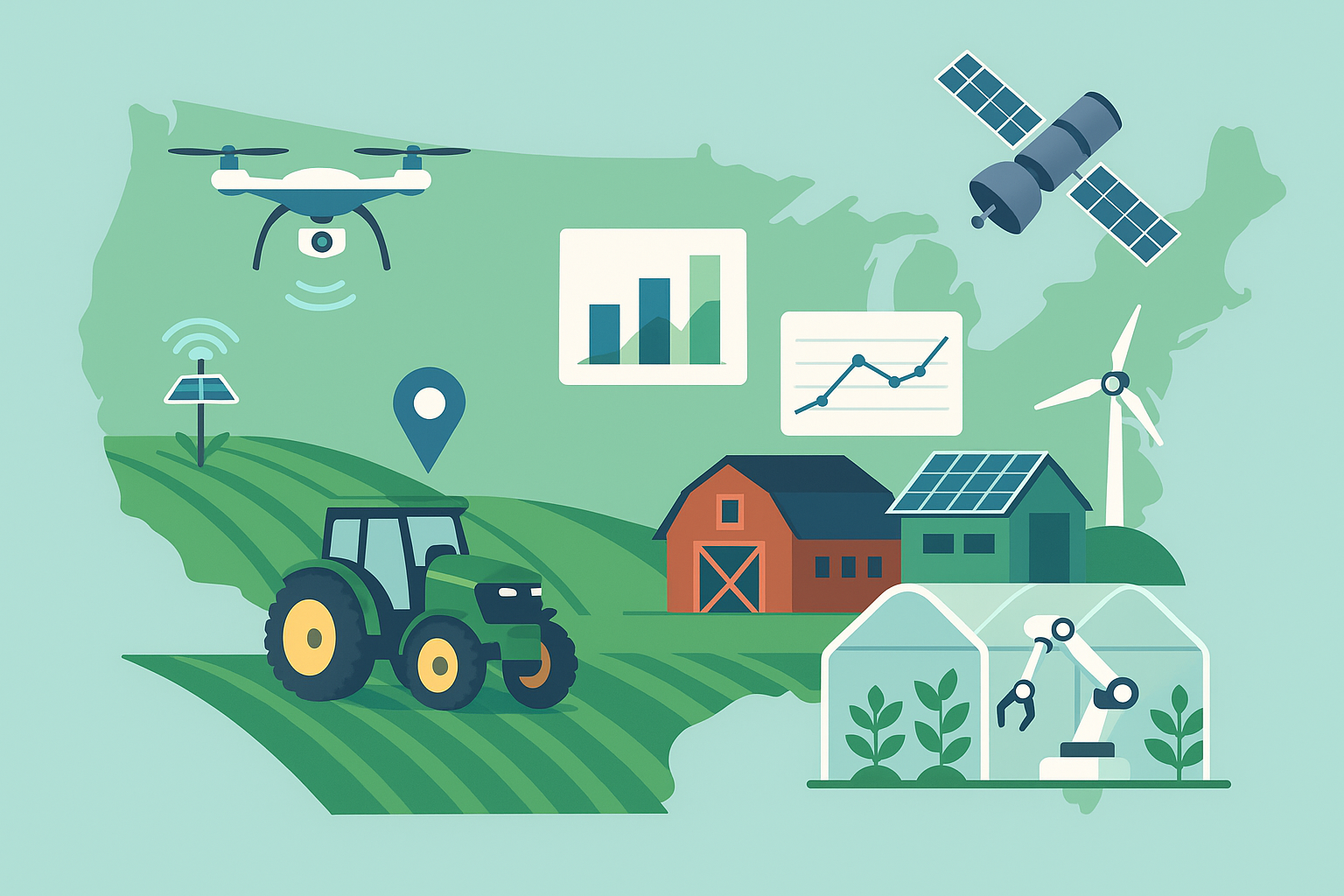
Most farm data today comes from what we can see: satellites scan canopies, drones map fields, and weather stations sample the air. Yet much of what drives yield happens out of sight, in the root zone where plants make or break their season. A growing class of agriculture technology—wireless underground sensor networks—aims to bring that hidden layer online. By burying connected probes that can communicate without wires, farms can track moisture, salinity, temperature, and nutrients directly where roots live, at a scale and persistence that aboveground tools rarely match.
Why go underground?
Surface observations infer what the root zone might be doing. But soils vary by the meter; a ridge dries faster than a swale, a trickle from a cracked pipe salts a narrow band, and a sand streak through a clay pan holds water differently than the next row over. Traditional soil probes address this with wires to aboveground loggers, which brings practical headaches: cables get snagged by machinery, chewed by rodents, degraded by sun, or simply become hazards. Wireless underground systems eliminate the umbilical. Each node is buried, sealed, and designed to transmit data without emerging to the surface, allowing longer-term placement in annual row crops and perennial blocks with far less risk of damage or theft.
Going underground also makes sensing more robust during weather. Wind, dust, and sun exposure can degrade aboveground devices precisely when data is needed most—during heatwaves or storms. Buried instruments are thermally and mechanically buffered, measuring the variable that matters to the plant—conditions at the root—rather than a proxy at the surface.
The physics problem: radio doesn’t like dirt
Soil is a lossy, complex medium. Its composition (sand, silt, clay), moisture, and salinity determine its electrical properties. As water content and salts rise, so does attenuation of electromagnetic waves. Frequencies commonly used by consumer IoT—2.4 GHz and even sub‑GHz bands—can be absorbed within centimeters to tens of centimeters in moist soils. That’s why early attempts to bury off‑the‑shelf radio modules often failed outside of lab plots.
To get reliable links underground, three approaches dominate:
- Magnetic induction (MI): Instead of radiating high‑frequency radio waves, MI uses low‑frequency, quasi‑static magnetic fields generated by coils. Magnetic fields couple through soil with far less sensitivity to moisture and salinity than electric fields. MI can support buried‑to‑buried or buried‑to‑surface links over a few meters with modest power, well‑suited to dense sensor clusters in orchards, vineyards, and high‑value vegetable beds.
- Low‑frequency RF: Pushing carrier frequencies down (often well below 1 MHz) can extend penetration, but requires larger antennas and careful design. Many practical systems compromise by creating a short, protected “stem” that brings a small part of the radio path near the surface while leaving the sensing elements at depth.
- Backscatter and hybrid methods: Recent research prototypes let buried tags modulate and reflect a signal from a surface reader, consuming microwatts rather than milliwatts. Others convert underground signals to acoustic or guided waves in specific structures (for example, along drip lines) before handing off to conventional radios at a gateway.
No single method wins everywhere. A citrus block with saline irrigation water behaves very differently from a Midwestern silt loam after rain. Practical deployments blend techniques: buried nodes talk short‑range to a near‑surface relay using MI, then hop to a farm gateway via LoRaWAN, cellular, or Wi‑Fi.
What gets measured—and why it matters
Underground networks are only as valuable as the sensors they carry. The most common payloads include:
- Volumetric water content: Capacitance or time‑domain reflectometry (TDR) probes quantify soil moisture, guiding irrigation to maintain optimal stress levels crop by crop and zone by zone.
- Soil salinity and electrical conductivity (EC): Critical in arid regions and under fertigation, EC trends flag salt accumulation before yield suffers and help schedule leaching fractions more precisely.
- Temperature and oxygen: Soil temperature controls germination and root activity; oxygen indicates waterlogging risks in heavy soils or poorly drained beds.
- Nutrients (nitrate, ammonium, potassium): Selective ion sensors are improving but remain sensitive to drift. Underground placement stabilizes temperature swings, improving signal quality and the economics of frequent calibration.
Integrating these data streams at the root zone sharpens decisions. In pivots and linears, variable‑rate irrigation maps become more than evapotranspiration estimates—they close the loop with actual in‑situ water status. In high‑value perennials, block‑level irrigation and fertigation can be tuned to differences between young and mature trees, or between canopy exposures, reducing stress swings that invite pests and disorders.
Deployment playbook: depth, density, and durability
Designing an underground network starts with the crop and equipment:
- Depth: Annual row crops often see sensors at 10–30 cm to capture the active root zone while staying below most tillage. Perennials may add deeper sensors (30–60 cm) to track subsoil dynamics and salt movement.
- Density: Heterogeneity drives density. Sandy fields with patchy irrigation uniformity benefit from more nodes per hectare. Uniform beds in controlled irrigation systems can do more with fewer, strategically placed nodes.
- Durability: Housings must resist corrosion, soil acids, and swelling clays. Smooth profiles, no sharp edges, and defined “no‑dig” geofences in the farm’s equipment guidance software reduce damage risk during cultivation.
- Access and retrieval: Long‑lived nodes are an asset only if serviceable. Many designs allow retrieval with a probe map and a slide hammer, or leave a locator element detectable from the surface.
Powering years underground
Battery changes are the Achilles’ heel of remote sensors. Underground, access is even harder. Modern systems stretch life by combining low‑power chips, aggressive duty cycling, and energy harvesting:
- Sleep-first firmware: Nodes wake briefly to sample, compress, and transmit before returning to deep sleep. Many operate with millijoules per day.
- Microbial fuel cells (MFCs): Electrodes harvest tiny currents from soil bacteria metabolizing organic matter. While power levels are low, research sites have shown multi‑month operation of simple sensing and backscatter links without batteries. Work is ongoing to ruggedize the chemistry for farm conditions.
- Thermal harvesting: Thermoelectric generators can exploit day‑night soil temperature gradients, particularly near the surface or in greenhouses. Output is modest but steady.
For now, most commercial systems pair long‑life primary batteries with firmware that adapts sampling rates to agronomic events—more data during irrigation or rain, less during steady states—balancing insight against longevity.
From dirt to dashboards: making the data useful
Underground data is inherently local. Turning it into decisions requires context:
- Edge processing: Simple algorithms on the node can detect thresholds or rate‑of‑change events, reducing redundant transmissions and surfacing anomalies faster.
- Data fusion: Combining underground sensors with canopy imagery, weather forecasts, and irrigation system telemetry transforms point measurements into actionable maps. For pivots, that means translating root‑zone deficits into nozzle‑by‑nozzle prescriptions. For drip, it can time pulses to avoid leaching while maintaining target tension.
- Open interfaces: Using widely adopted data models (for example, SensorThings or MQTT schemata) eases integration with existing farm management systems and reduces lock‑in.
What can farms expect to gain?
Benefits fall into three buckets:
- Water: Field studies with root‑zone feedback often report double‑digit percentage reductions in applied water for equivalent or better yield, especially where irrigation uniformity is imperfect. Underground sensing makes those savings repeatable by reducing guesswork and enabling finer zoning.
- Nutrients: Tracking nitrate breakthrough below the main root zone helps tighten fertigation timing and rates, cutting costs and keeping regulators satisfied in sensitive watersheds.
- Resilience: Early signals of waterlogging, compaction, or salt creep give managers time to intervene—adjust an irrigation set, pulse a leach, skip a pass—to prevent small issues becoming season‑long drags.
Return on investment hinges on crop value, water price and availability, and the ability to act on the data. High‑value specialty crops, orchards under deficit irrigation, and regions with strict water accounting often see the fastest payback.
Limits, caveats, and what to watch
Wireless underground systems are not drop‑in magic. A few practical realities matter:
- Link budgets change with the weather: After heavy rain or fertigation, soil properties shift, shrinking communication range. Robust designs plan for worst‑case moisture, not just average conditions.
- Sensor drift is real: EC and ion‑selective sensors require periodic checks. Underground placement helps, but a seasonal calibration plan should be part of any deployment.
- Interference and obstacles: Metal pipes, rebar in trellises, and even dense root mats can detune antennas or MI coils. Site surveys and small pilots reduce surprises.
- Cyber and data stewardship: Even dirt data is business data. Secure boot, encrypted links, and clear ownership terms protect growers and downstream partners.
- End‑of‑life: Buried electronics must not become buried e‑waste. Favor designs with retrieval plans, recyclable housings, and take‑back programs.
Policy and interoperability
Most underground systems operate in unlicensed industrial, scientific, and medical (ISM) bands, subject to local power and duty‑cycle limits. As deployments scale, two needs are emerging: clearer guidance on radio use in soil (where propagation differs from air) and common data structures so growers can mix sensor vendors without losing cohesion. Standards bodies and industry groups are beginning to address both, but buyers should still ask hard questions about how easily a given product’s data can move and persist beyond a single platform.
The road ahead
Three trends could carry wireless underground sensing from niche to norm:
- Ultra‑low‑power radios and backscatter: As buried nodes need less energy to speak, energy harvesting becomes practical and battery swaps rarer. Expect hybrid links—buried backscatter to a surface relay, then long‑range to the cloud—to proliferate.
- Better chemistry and materials: Corrosion‑proof coatings, soil‑friendly plastics, and flexible coils will extend lifespans and simplify installation in challenging soils.
- Software that speaks agronomy: The leap from numbers to recommendations is where value is realized. Models that learn field‑specific moisture dynamics, reconcile them with weather and canopy state, and propose clear irrigation and fertigation actions will separate tools from toys.
Farming is ultimately about managing risk at biological and weather time scales. Making the root zone visible, reliably and affordably, chips away at a major source of uncertainty. If the last decade pulled agriculture’s eyes to the sky with satellites and drones, the next may direct ears to the soil—listening to a network of quiet, buried sentinels that tell growers what the plants already know.